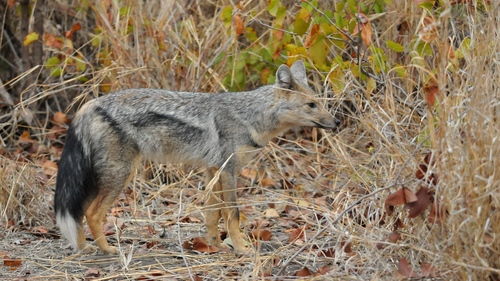
Side-striped Jackal
Lupulella adusta
The Side-striped Jackal is a master of the shadows, blending perfectly into the African bush with its grizzled coat and secretive nature. Distinguished by its unique white-tipped tail, this elusive canine is a prize for any backyard camera enthusiast.
Quick Identification
Size
Length: 65–81 cm (26–32 in); Tail: 30–41 cm (12–16 in); Weight: 7–12 kg (15–26 lb)
Colors
Buff-gray to dark charcoal coat with a faint white stripe along the flanks; the tail is dark with a very distinctive white tip.
Key Features
- Distinctive white tip at the end of a dark, bushy tail
- Faint white lateral stripe bordered by a dark lower line
- Blunter muzzle and smaller, more rounded ears than other jackal species
- Stocky, dog-like build with a grizzled coat
When You’ll See Them
Behavior
The Side-striped Jackal is the most elusive and least aggressive of the African jackals. While its cousins are often seen scavenging in the open during the day, the side-striped variety is predominantly nocturnal and crepuscular, preferring to stay near thick cover. They are remarkably well-adapted to living near humans, often utilizing the 'edges' of suburban gardens and farms without ever being detected by residents.
Socially, these jackals are monogamous and typically travel in pairs or small family units. They are less territorial than the Black-backed Jackal and are known for their varied vocalizations, which include a distinctive 'bloop' sound and yaps that differ significantly from the long howls of other canines. Because they are shy and non-confrontational, they usually flee at the first sign of human presence.
EverydayEarth exclusive
Camera Tips
To capture a Side-striped Jackal on your trail camera, placement is everything. These animals are 'edge' specialists, meaning they prefer to travel along the boundaries where different habitats meet—such as the line where a manicured lawn meets a wild thicket, or along a fence line. Position your camera about 12 to 18 inches off the ground. This low angle is perfect for capturing the diagnostic white tip of the tail and the subtle side stripe that defines the species.
Because they are significantly more nocturnal than other jackals, you must ensure your camera’s infrared (IR) flash is working optimally. High-quality black LED (no-glow) flashes are preferred to avoid spooking these shy canines. Set your camera to a multi-shot burst mode; because the side stripe can be faint and depends on lighting, having three or four consecutive photos gives you a much better chance of seeing the markings as the animal moves through the frame.
If you are trying to attract them to a specific spot, remember that they are as much fruit-eaters as they are predators. While meat-based lures work, sweet-smelling fallen fruits like figs or even a smear of peanut butter on a nearby log can be highly effective. During the dry season, a consistent water source like a low-profile basin will almost certainly attract them, as they need to drink regularly. Always aim the camera north or south to avoid sun-glare during the dawn and dusk hours when they are most active.
Similar Species
Species that look similar or are commonly confused with Side-striped Jackal.
Frequently Asked Questions
Record Side-striped Jackal at your habitat
Connect a camera to start building your own species record — AI identifies every visitor automatically.