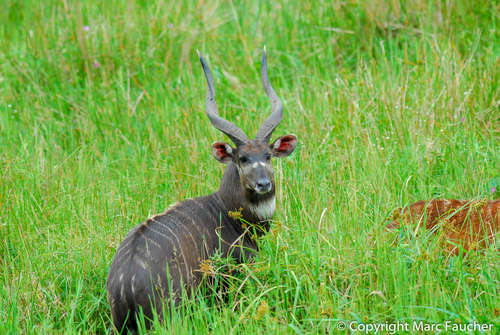
Sitatunga
Tragelaphus spekii
Meet the 'ghost of the swamp,' a shy antelope that has evolved to walk on mud and disappear underwater. With its water-repellent coat and specialized hooves, the Sitatunga is a true marvel of African wetland adaptation.
Quick Identification
Size
Height: 33-45 in (85-115 cm); Weight: 110-275 lbs (50-125 kg); Length: 53-67 in (135-170 cm)
Colors
Males are grayish-brown to chocolate; females and young are bright chestnut. Both have white spots and 6-10 white stripes on the body.
Key Features
- Extremely long, splayed hooves (up to 4 inches) for walking on mud
- Twisted, lyre-shaped horns (males only) reaching 18-35 inches
- Shaggy, oily, water-repellent coat
- Distinctive white facial spots and two white patches on the throat
When You’ll See Them
Behavior
The Sitatunga is a master of the marsh, uniquely adapted to a semi-aquatic lifestyle that most other antelopes avoid. They are incredibly shy and elusive, spending the heat of the day resting on platforms of trampled reeds in the deepest parts of the swamp. When threatened, they exhibit a remarkable survival strategy: they submerge themselves almost entirely underwater, leaving only their nostrils exposed to breathe while they wait for predators to pass.
Socially, these antelopes are primarily solitary, though they occasionally form small, loose groups. They are excellent swimmers and are known to move through deep water to reach isolated islands of vegetation. Because they live in such dense, tangled environments, they rely heavily on a network of well-beaten paths or 'tunnels' through the papyrus and reeds to navigate their territory.
EverydayEarth exclusive
Camera Tips
Capturing the Sitatunga on camera is a challenge that requires an understanding of their 'tunnel' system. Look for flattened paths through tall reeds or papyrus where the vegetation has been pushed aside; these are their primary highways. Mount your camera on a sturdy stake or a tree trunk at the edge of a marsh clearing, roughly 3 feet (1 meter) off the ground. A low angle is essential if you want to capture clear shots of their most distinctive feature: the elongated, splayed hooves designed for walking on soft mud.
Because the marsh environment is naturally dark and the Sitatunga is most active during the low-light hours of dawn and dusk, your camera’s sensor quality is paramount. Use a camera with high-quality infrared flash (preferably 'No-Glow' to avoid spooking this timid species) and set your trigger speed to the fastest possible setting. High humidity in swamps often leads to lens fogging, so consider using an anti-fog spray on the exterior lens and placing several large desiccant packets inside the camera housing to protect the electronics.
If you are setting up in a residential area that borders a wetland, you can occasionally draw them into view using mineral licks, though natural movement remains the most reliable trigger. During the peak of the dry season, focus your camera placement on the last remaining patches of permanent water. As smaller marshes dry up, Sitatungas are forced to congregate in higher densities around these water sources, making it the best time of year for high-volume captures.
Pay close attention to the background of your shots. The dense, vertical lines of reeds can often confuse autofocus systems. If your camera allows for it, set a manual focus zone or choose a spot where there is a small, clear opening in the vegetation to ensure the animal is the sharpest part of the image rather than the surrounding grass.
Similar Species
Species that look similar or are commonly confused with Sitatunga.
Frequently Asked Questions
Record Sitatunga at your habitat
Connect a camera to start building your own species record — AI identifies every visitor automatically.