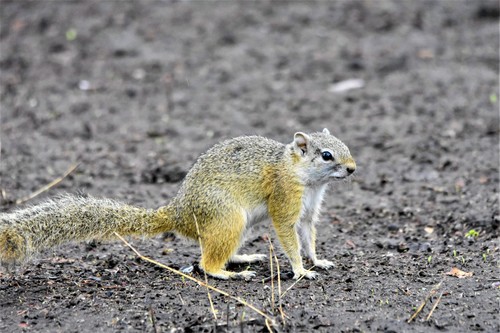
Smith's Bush Squirrel
Paraxerus cepapi
The Smith’s Bush Squirrel is a charismatic and vocal acrobat of the southern African woodlands. Known for its yellowish feet and social charm, it’s a frequent and entertaining visitor to any backyard camera in the region.
Quick Identification
Size
Head-body 17–20 cm (6.7–7.9 in), tail 15–20 cm (5.9–7.9 in); weight 150–250 g (5.3–8.8 oz)
Colors
Grizzled grey-brown upperparts, pale whitish or cream underparts, with a distinct yellowish-buff wash on the limbs and feet
Key Features
- Distinctive yellow-buff feet and legs
- Prominent pale ring around the eyes
- Slender bushy tail often flicked or held over the back
- Large, dark, alert eyes
When You’ll See Them
Sightings on EverydayEarth
Jul 27, 2026
A small Smith's bush squirrel is busy at the water's edge, foraging or drinking in the early morning light. The water is calm, reflecting the surrounding brush and trees.
Jul 26, 2026
A Smith's Bush Squirrel is perched atop a weathered tree stump in the foreground. It remains mostly stationary but alert, twitching its head to monitor the surroundings of the quiet waterhole.
Jul 21, 2026
A Smith's Bush Squirrel appears on the left bank of the water hole. It scurries across the dry earth with quick, jerky motions, its bushy tail clearly visible as it moves toward the cover of the nearby bushes.
Jul 18, 2026
A Smith's Bush Squirrel is briefly visible on the far left bank near the water's edge. It scurries across the ground for a second before moving out of the camera's frame. The rest of the scene is a quiet morning at the water pan with no other animal activity.
Jul 14, 2026
A Smith's Bush Squirrel is sitting on the muddy bank of the watering hole. It remains relatively still throughout the clip, occasionally adjusting its posture while scanning the surrounding woodland environment.
Jul 14, 2026
A Smith's Bush Squirrel is active near the edge of the waterhole, foraging among the rocks and low vegetation at the base of a small bush.
Geographic range
Where Does the Smith's Bush Squirrel Live?
The Smith's Bush Squirrel is a signature resident of the southern Afrotropics. Its native range spans across Southern Africa, with high population densities found in South Africa, Botswana, Zimbabwe, and Namibia. They also thrive in the woodland regions of Mozambique, Zambia, Malawi, and southern Angola, remaining largely resident throughout the year without any migratory patterns.
Basemap © OpenStreetMap contributors
Behavior
Smith’s Bush Squirrels are highly social and vocal mammals, typically found in small family groups of up to 12 individuals. They are strictly diurnal, meaning they are active during the day, spending their time foraging both on the ground and in the canopy. They are famous for their complex communication system, which includes a variety of clicks, whistles, and chirps used to alert the group to predators like raptors or snakes.
These squirrels are territorial and use scent glands in their cheeks to mark their home range. At night, the family huddles together in tree hollows, which they line with grass and leaves for insulation. In suburban settings, they can become quite habituated to humans, often nesting in the eaves of roofs or visiting bird feeders to scavenge seeds.
EverydayEarth exclusive
Camera Tips
To capture high-quality footage of Smith’s Bush Squirrels, position your camera about 1 to 1.5 meters (3-5 feet) off the ground. These squirrels are arboreal but spend significant time on the ground foraging, so a camera aimed at the base of a large Acacia or Mopane tree—especially one with visible hollows—is ideal. They often use specific 'runways' or horizontal branches to navigate between trees; finding one of these paths is the key to consistent captures.
Using a lure can significantly improve your results. A small platform or flat rock stocked with unsalted peanuts, sunflower seeds, or pieces of fruit like apple or papaya will keep them stationary long enough for the AI to trigger. Because these squirrels are extremely fast and 'twitchy' in their movements, set your camera to a high-speed burst mode or a short video clip (10-15 seconds) to catch their social interactions and tail-flicking behavior.
Timing is everything with this species. They are most active in the early morning shortly after sunrise and again in the late afternoon before dusk. During the hottest part of the day, they tend to remain still in the shade. If you are using a trail camera in a garden, placing it near a bird bath can also yield great results, as they need to drink regularly, especially during the dry winter months.
Frequently Asked Questions
Record Smith's Bush Squirrel at your habitat
Connect a camera to start building your own species record — AI identifies every visitor automatically.