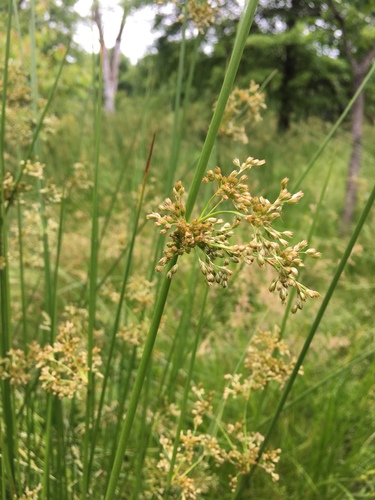
Soft Rush
Juncus effusus
The structural architect of the backyard pond, Soft Rush provides a striking green silhouette while serving as a bustling hub for frogs and dragonflies. Its smooth, fountain-like stems remain vibrant throughout the seasons, offering a glimpse into the hidden world of wetland wildlife.
Quick Identification
Size
Stems typically grow 60–120 cm (2–4 ft) tall, forming clumps 60–90 cm (2–3 ft) wide.
Colors
Glossy bright green to deep olive stems; flower clusters are yellowish-green to golden brown.
Key Features
- Smooth, cylindrical stems without joints or nodes
- Flower clusters appear to burst from the side of the stem
- Dense, fountain-like clumping habit
- Stems contain a solid, white spongy pith
When You’ll See Them
Behavior
Soft Rush is a hardy, clump-forming perennial that serves as a cornerstone of wetland ecosystems. Unlike grasses, it lacks nodes on its stems, giving it a sleek, architectural appearance. It grows in a 'tussock' formation, where old growth at the base provides a protective mulch for new shoots, creating a micro-habitat that is often several degrees cooler than the surrounding air. This makes it a preferred sanctuary for small amphibians and insects during the heat of the day.
Ecologically, Soft Rush is a workhorse. It spreads via short rhizomes, forming a dense root mat that stabilizes soil and filters pollutants from runoff. While it doesn't move across a landscape quickly, its presence often indicates a high water table or consistent moisture. For the backyard enthusiast, it is a low-maintenance plant that offers year-round structure, standing tall even under the weight of winter snow.
EverydayEarth exclusive
Camera Tips
When setting up an AI-powered camera to monitor Soft Rush, your primary goal isn't just to watch the plant grow, but to use the plant as a 'stage' for the wildlife it attracts. Position your camera about 12 to 18 inches off the ground, angled slightly upward. This perspective captures the elegant vertical lines of the stems and makes it easier for AI to identify frogs, toads, or dragonflies that use the rush as a perch or hiding spot. Because Soft Rush often grows near water, ensure your camera is securely mounted on a stake to prevent it from sinking into soft mud.
Wind can be a significant challenge when monitoring tall, thin plants like Soft Rush. To avoid thousands of 'false positive' triggers from swaying stems, adjust your camera's sensitivity to 'medium' or 'low' if it supports motion-based triggering. Alternatively, use a camera with 'zone detection' to exclude the very tops of the rushes where movement is most extreme, focusing the trigger area on the more stable base of the plant where animals are likely to emerge from the foliage.
For the best visual results, utilize backlighting. During the 'golden hours' of early morning or late afternoon, position the camera so the sun is behind the plant. The translucent green of the stems will glow, and the light brown flower clusters will be beautifully rimmed with light. This high-contrast lighting helps AI algorithms better distinguish the thin stems from the background. If you are interested in the life cycle of the plant itself, set your camera to time-lapse mode, capturing one frame every 4-6 hours from late spring through mid-summer to witness the rapid upward thrust of the new stems.
Similar Species
Species that look similar or are commonly confused with Soft Rush.
Frequently Asked Questions
Record Soft Rush at your habitat
Connect a camera to start building your own species record — AI identifies every visitor automatically.