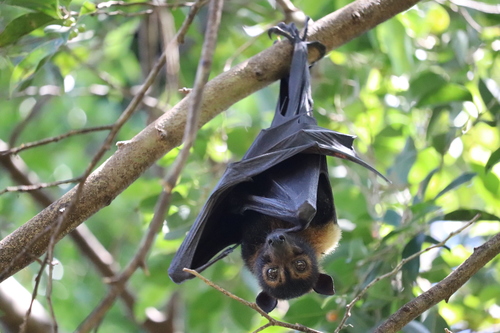
Spectacled Flying-fox
Pteropus conspicillatus
Meet the 'forest gardener' of the tropics. With its distinctive golden eye-patches and impressive meter-wide wingspan, the Spectacled Flying-fox is a charismatic nocturnal icon of Australia's northern rainforests.
Quick Identification
Size
Head-body length of 22-25 cm (8.7-9.8 in); wingspan up to 1 m (3.3 ft); weight between 400-1000 g (0.8-2.2 lbs)
Colors
Primarily black or dark grey body fur with distinctive pale yellow or straw-colored rings around the eyes and a matching mantle across the neck and shoulders.
Key Features
- Prominent pale yellow 'spectacles' encircling the eyes
- Large straw-colored patch of fur on the back of the neck and shoulders
- Blackish snout and ears
- Large, leathery wings with no visible tail
When You’ll See Them
Sightings on EverydayEarth
Aug 1, 2026
In the late afternoon light, several flying foxes are active within a mesh enclosure. A Spectacled Flying-fox hangs prominently in the center, shifting its position and grooming while others remain suspended from the mesh ceiling in the background. Toward the end of the clip, a large bat crawls into view from the upper left, showing its full wingspan as it maneuvers along the enclosure's frame.
Jul 31, 2026
Several flying foxes are roosting under a mesh ceiling. They are mostly stationary, wrapped tightly in their wings, though one individual on the left shifts slightly. Their characteristic fox-like heads and pointed ears are occasionally visible as they adjust their positions.
Jul 30, 2026
Several flying foxes are roosting in a large enclosure, hanging upside down from the wire mesh ceiling. They are seen engaging in typical daytime resting behaviors, including grooming their fur, shifting their grip on the mesh, and occasionally stretching or flapping their wings. One individual is positioned extremely close to the camera lens on the left, while others are clearly visible in the mid-ground and background.
Jul 30, 2026
Several Spectacled Flying-foxes are resting within an enclosure, hanging upside down from the mesh ceiling. One individual in the center-right of the frame is particularly active, shifting its weight and adjusting its grip on the mesh with its feet while others remain mostly tucked into their wings. The background shows lush green vegetation through the enclosure's screen.
Jul 29, 2026
Several flying foxes are seen hanging from the mesh ceiling of a large enclosure. They are mostly resting, with their wings wrapped around their bodies. One individual on the far right occasionally shifts its head, and a string of sliced fruit hangs undisturbed in the center of the frame.
Jul 29, 2026
Several Spectacled Flying-foxes are seen hanging from the mesh roof of an enclosure. They are active during the day, grooming their fur with their hind claws and stretching their large, dark wings. One individual in the foreground shifts its position, providing a clear view of the characteristic 'spectacles' around its eyes.
Behavior
Spectacled Flying-foxes are highly social 'megabats' that live in massive colonies known as camps, which can number in the tens of thousands. During the day, these camps are a hive of activity, filled with the sounds of chattering and the sight of bats fanning themselves with their wings to stay cool. They are incredibly intelligent and have complex social structures, often returning to the same roosting sites for generations.
As dusk falls, the colony takes flight in a spectacular 'fly-out,' heading to foraging grounds that can be many kilometers away. In suburban environments, they are frequent visitors to backyard fruit trees and flowering gums. While they are often viewed as noisy neighbors, they are actually 'forest gardeners,' playing a critical role in pollination and seed dispersal for the tropical rainforests of North Queensland.
EverydayEarth exclusive
Camera Tips
To capture high-quality footage of a Spectacled Flying-fox, you need to look up. These bats are strictly arboreal and will rarely, if ever, be found on the ground. Position your camera at least 2 to 3 meters (6-10 feet) high, ideally strapped to the trunk of a fruiting or flowering tree like a Mango, Fig, or Grevillea. Angle the camera slightly upward to capture them as they land on outer branches or hang upside down to feed. Using a telephoto lens or a camera with a narrower field of view can help you get detailed 'face shots' of their unique spectacles.
Since they are most active under the cover of darkness, a camera with high-quality Infrared (IR) LEDs is non-negotiable. 'No-Glow' IR is preferable to avoid startling the bats, although they are generally less sensitive to red-glow than ground mammals. Set your trigger speed to its fastest possible setting (0.2s or less), as flying-foxes can be surprisingly quick when landing or bickering over a piece of fruit. Increase your video length to 20-30 seconds to capture their fascinating grooming and feeding behaviors.
Timing is everything with this species. During the summer months (October to December), females are often carrying pups, providing a rare chance to film maternal behavior. Look for 'splatter' marks on leaves or half-eaten fruit on the ground as a sign that you've found a favorite feeding branch. If your camera allows for scheduling, set it to run only from dusk till dawn to save battery and SD card space, as you won't see much activity during the daylight hours unless your camera is positioned near a roosting camp.
Similar Species
Species that look similar or are commonly confused with Spectacled Flying-fox.
Black Flying-fox
Lacks the yellow 'spectacle' rings around the eyes and has a darker, less prominent mantle on the neck.
Grey-headed Flying-fox
Has a distinct grey head and a reddish-orange collar that encircles the entire neck.
Little Red Flying-fox
Much smaller with reddish-brown fur and more translucent wings; lacks the eye-rings.
Frequently Asked Questions
Record Spectacled Flying-fox at your habitat
Connect a camera to start building your own species record — AI identifies every visitor automatically.