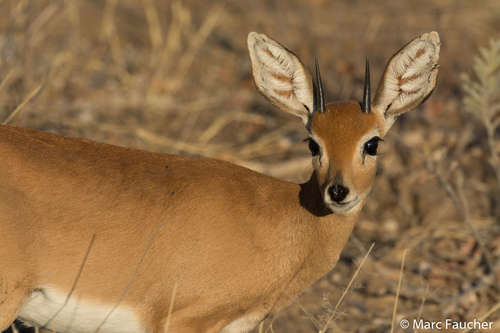
Steenbok
Raphicerus campestris
With their oversized ears and dainty gait, the steenbok is the crown jewel of backyard African wildlife. These solitary, spirited antelopes are masters of camouflage, making a camera trap discovery feel like finding hidden treasure.
Quick Identification
Size
Shoulder height: 45-60 cm (18-24 in); Weight: 7-16 kg (15-35 lbs)
Colors
Bright rufous-fawn to reddish-brown coat with a stark white underside. Males possess short, straight, needle-like black horns.
Key Features
- Oversized, leaf-shaped ears with internal black-and-white 'fingerprint' markings
- Slender, dainty build with a short, barely visible tail
- White rings around the eyes and a dark wedge-shaped marking on the bridge of the nose
- Males have smooth, vertical horns 7-19 cm long
When You’ll See Them
Sightings on EverydayEarth
Jul 26, 2026
A male Steenbok forages along the sandy, tiered bank of the Olifants River. It moves cautiously across the rocky terrain, pausing briefly to sniff at the ground before continuing its path along the shoreline.
Behavior
The steenbok is a solitary and fiercely territorial small antelope. Unlike many other bovids that live in herds, steenboks are usually seen alone, except during the brief mating season or when a mother is raising a lamb. They are known for their 'freeze' defense mechanism; when they sense a predator, they will crouch low in the grass and remain perfectly still until the threat is nearly upon them, at which point they bolt in a zigzag pattern. Interestingly, they are also known to take refuge in abandoned aardvark burrows to escape heat or danger.
These antelopes are highly adaptable to human presence and often thrive on the fringes of suburban developments or on small agricultural holdings. They are monogamous, with pairs sharing a territory but living largely independent lives within it. They are meticulous about their territory, often utilizing specific 'latrine' sites where they scrape the earth, defecate, and then carefully cover their dung with soil to mask their scent from predators.
EverydayEarth exclusive
Camera Tips
To capture the perfect steenbok shot, positioning is everything. Because these antelopes are small, mounting your camera too high will result in shots of their backs or missed triggers entirely. Aim for a mounting height of about 12 to 18 inches (30-45 cm) off the ground. This 'eye-level' perspective captures their delicate facial markings and those iconic large ears beautifully. Angle the camera parallel to the ground in flat garden areas or clearings.
Look for specific signs of activity before choosing your spot. Steenboks are unique among small antelopes because they bury their dung in shallow scrapes. If you find a patch of turned-over earth with small, bean-shaped pellets, you’ve found a regular 'latrine.' Setting your camera nearby is almost a guarantee for a sighting, as they return to these spots frequently to mark their territory. Additionally, they love browsing on fallen fruits or young succulent plants, so placing a camera near a garden bed with native shrubs or a low-lying water trough can be very effective.
Because steenboks are quite skittish and have lightning-fast reflexes, use a camera with a high trigger speed—ideally 0.3 seconds or less. If your camera allows for 'Burst Mode' or 'Photo + Video,' set it to take 3-5 photos per trigger. This increases your chances of getting a clear image if the animal is startled by the camera's shutter or flash. While they are active during the day, they often visit backyards at dawn or dusk to avoid human activity; therefore, ensuring your infrared flash is set to 'No Glow' (940nm) will prevent spooking them into a flight response.
During the dry season, steenboks are more likely to visit specific spots for moisture. While they can survive without standing water by eating succulent roots, a low-profile bird bath or a ground-level water feature is an irresistible lure. Position your camera about 5-8 feet away from the water source to ensure the animal is fully in the frame. If you are using video, a 15-second clip is usually enough to capture their cautious drinking behavior and the way they constantly flick their ears to listen for threats.
Similar Species
Species that look similar or are commonly confused with Steenbok.
Frequently Asked Questions
Record Steenbok at your habitat
Connect a camera to start building your own species record — AI identifies every visitor automatically.