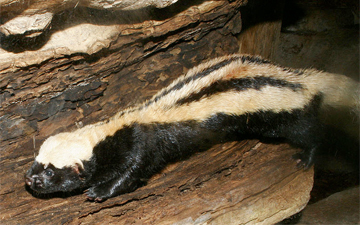
Striped Weasel
Poecilogale albinucha
The Striped Weasel is a sleek, nocturnal hunter that acts as nature's most efficient pest control. With its bold racing stripes and subterranean skills, this elusive mustelid is a prize find for any backyard explorer.
Quick Identification
Size
Body length 24–35 cm (9.5–14 in); Tail length 13–23 cm (5–9 in); Weight 230–380g (0.5–0.8 lbs)
Colors
Jet black body with four prominent white-to-yellowish stripes running from the head to the tail; the tail is entirely white and bushy.
Key Features
- Slender, elongated 'serpentine' body
- Four white longitudinal stripes on a black back
- Entirely white, bushy tail
- Very short legs and small, rounded ears
When You’ll See Them
Behavior
The Striped Weasel is a solitary and remarkably secretive predator. Despite its small size, it is a fierce hunter with a metabolism that requires it to be almost constantly on the lookout for its next meal. While they are capable of digging their own burrows, they frequently 'repurpose' the tunnels of the rodents they have recently hunted. They are known for a unique hunting style where they use their flexible bodies to corner prey in tight underground spaces.
When threatened, the Striped Weasel has a defense mechanism similar to a skunk; it can emit a pungent, foul-smelling musk from its anal glands to deter larger predators. In suburban environments, they are generally shy and avoid direct contact with humans, though they are highly beneficial to have around as they provide excellent natural pest control for gardens.
EverydayEarth exclusive
Camera Tips
Capturing a Striped Weasel on camera requires a ground-level approach. Because these mammals are so low-slung, a camera mounted at a standard 'deer height' will likely miss them entirely or only catch a blurry tail. Position your camera no more than 10–15 centimeters (4–6 inches) off the ground. Aim the lens along 'linear features' like the base of a garden wall, a fence line, or a dense hedge, as these weasels prefer to stay close to cover while moving through open spaces.
Since they are incredibly fast and move with a fluid, undulating gait, we highly recommend using video mode rather than still photos. A 10–20 second clip is much more likely to capture a clear identification than a still shot that might just show a black-and-white blur. If your camera allows it, set the trigger speed to its fastest setting and reduce the 'PIR delay' to zero to catch them as they dart across the frame.
To encourage a visit, you can use scent lures rather than bulky food baits which might attract unwanted larger scavengers. A small amount of oily fish (like sardines) or even commercial mustelid lure placed inside a perforated PVC pipe will keep the weasel in front of the camera long enough to get a great shot. They are also attracted to the sound of distressed rodents, so placement near known rat or mole burrows is often very successful.
Check your camera's night vision settings. Because the Striped Weasel has high-contrast black and white fur, standard infrared flashes can sometimes 'blow out' the white stripes, leaving you with a glowing white blob. If your camera has an 'Adjustable IR' or 'High/Low' flash setting, try the lower setting to preserve the detail of their unique markings.
Similar Species
Species that look similar or are commonly confused with Striped Weasel.
Frequently Asked Questions
Record Striped Weasel at your habitat
Connect a camera to start building your own species record — AI identifies every visitor automatically.