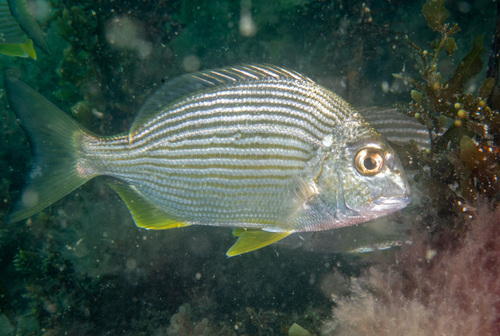
Tarwhine
Rhabdosargus sarba
With its shimmering pinstripes of gold and a friendly, schooling nature, the Tarwhine is a silver treasure of our coastal backyards. Whether under a private jetty or in a sun-drenched estuary, these resilient fish are a delight to discover on camera.
Quick Identification
Size
Typically 25 to 40 cm (10–16 in) in length; can reach a maximum of 80 cm (31 in) and weigh up to 3 kg (6.6 lbs).
Colors
Brilliant silver body with many horizontal golden-yellow lines following the scale rows; pelvic and anal fins are typically bright yellow.
Key Features
- Distinct golden-yellow longitudinal lines along the body
- Rounded, blunt snout profile
- Bright yellow pelvic and anal fins
- Deep, compressed silvery body shape
When You’ll See Them
Geographic range
Where Does the Tarwhine Live?
The Tarwhine is a widespread resident of the Indo-West Pacific, spanning a massive territory from the Red Sea and the eastern coast of Africa across to the waters of Japan, China, and down to Australia. In Australia, they are a staple sight along the southern and eastern coastlines, thriving in the nutrient-rich estuaries of New South Wales and Queensland. They are native to these warm-temperate and subtropical regions and have not been widely introduced outside their natural Indo-Pacific range.
Basemap © OpenStreetMap contributors
Behavior
These fish are protandrous hermaphrodites, a fascinating biological trait where individuals begin their life as males and may transition into females as they grow larger. This social and biological flexibility allows them to maintain stable populations across various environments. In suburban coastal areas, they are remarkably bold and are often seen hovering around jetties and boat ramps, waiting for scraps or disturbed sediment.
EverydayEarth exclusive
Camera Tips
To ensure a high volume of activity, utilize a berley (chum) dispenser. A simple mesh bag filled with crushed oyster shells, bread, or minced fish scraps suspended just above the camera’s field of view will draw schools of Tarwhine within minutes. They are particularly active during the rising tide, as the incoming water brings fresh nutrients into the estuaries. Timing your recording to start two hours before high tide and end an hour after will maximize your chances of seeing large, healthy specimens.
Lighting is the biggest challenge for underwater backyard cameras. Position your lens so the sun is behind the camera or directly overhead to avoid silhouetting the fish. Use a high frame rate setting (at least 60fps) to capture the sharp, reflective glint of their silver scales and the delicate golden lines, which can blur at lower speeds. If you are using motion-tracking AI, ensure the zone is set away from swaying seagrass to avoid false triggers while maintaining high sensitivity for the rapid, darting movements characteristic of the Sparidae family.
Similar Species
Species that look similar or are commonly confused with Tarwhine.
Frequently Asked Questions
Record Tarwhine at your habitat
Connect a camera to start building your own species record — AI identifies every visitor automatically.