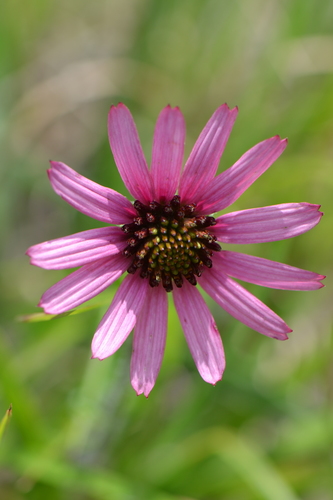
Tennessee purple coneflower
Echinacea tennesseensis
A rare survivor of the Tennessee limestone glades, this unique coneflower is famous for its 'upturned' petals and incredible resilience. Once on the brink of extinction, it is now a shining success story of Southern conservation.
Quick Identification
Size
Stems typically reach 30–60 cm (12–24 inches) in height with a spread of 30–45 cm (12–18 inches).
Colors
Deep pink to purple ray florets (petals) with a central cone that transitions from dark copper-orange to brownish-black.
Key Features
- Ray florets (petals) curve distinctly forward and upward toward the center
- Central spiny cone of coppery-orange
- Narrow, lance-shaped leaves with a rough, hairy texture
- Endemic to limestone cedar glades of Tennessee
When You’ll See Them
Geographic range
Where Does the Tennessee purple coneflower Live?
This rare botanical treasure is a true North American native with one of the most restricted ranges on the continent. In the wild, it is found exclusively in the Central Basin of Tennessee, specifically within a few counties surrounding Nashville. While it has been successfully introduced to native plant gardens and restoration sites across the Southeastern United States, its natural footprint remains confined to these unique Tennessee limestone glades.
Basemap © OpenStreetMap contributors
Behavior
The Tennessee purple coneflower is a perennial wildflower characterized by its incredible resilience to harsh, rocky conditions. Unlike most other members of the Echinacea genus, its petals do not droop; instead, they curve forward and upward as if reaching for the sun. This growth habit is a primary identifier for the species. It is a sun-loving plant that has adapted to the thin, alkaline soils of limestone glades where other plants struggle to survive.
In its natural ecosystem, it plays a vital role as a nectar source for a variety of pollinators. It attracts a wide array of native bees, butterflies, and occasional hummingbirds. Its blooming cycle is quite long, often lasting from early June through August, providing a consistent food source during the height of summer. Because it is highly localized, its presence in a backyard or glade indicates a very specific type of healthy, limestone-rich environment.
EverydayEarth exclusive
Camera Tips
To capture the Tennessee purple coneflower effectively, position your camera on a low tripod or ground mount to emphasize the unique forward-curving petals. Setting the camera at a slight upward angle will showcase the distinct 'cup' shape of the flower head against the sky or background foliage. Because this plant is a pollinator magnet, setting your camera to a fast shutter speed or high-frame-rate video mode is essential for freezing the motion of visiting butterflies and bees.
Lighting is critical for this species; the deep purple hues can become washed out in harsh midday sun. The 'golden hours'—shortly after sunrise or before sunset—provide a warm, soft light that saturates the purple petals and makes the coppery-orange central cone pop. If your camera allows for macro settings, focus specifically on the cone's texture, as the intricate patterns of the disk florets are visually stunning in high resolution.
For those interested in the 'wildlife' aspect of the plant, consider a time-lapse setting. A frame every 10–15 minutes throughout a sunny day can document how the flower heads track the light or how they slowly open over the course of a week. If placing a trail camera, ensure it is positioned about 18–24 inches from the plant to capture clear images of goldfinches, which frequently land on the dried cones in late summer to harvest the seeds.
Similar Species
Species that look similar or are commonly confused with Tennessee purple coneflower.
Purple Coneflower
The petals on the common purple coneflower droop downward away from the cone, whereas the Tennessee species has petals that curve forward.
Pale Purple Coneflower
This species has much narrower, drooping petals and white-colored pollen, compared to the Tennessee coneflower's yellow pollen.
Frequently Asked Questions
Record Tennessee purple coneflower at your habitat
Connect a camera to start building your own species record — AI identifies every visitor automatically.