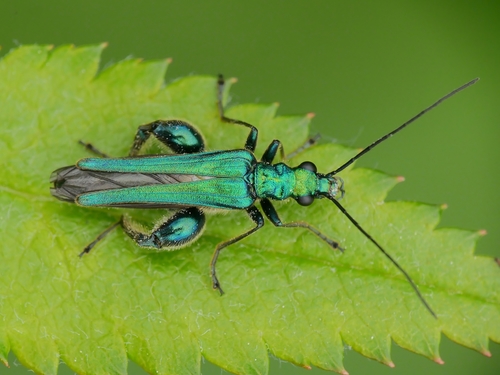
Thick-legged Flower Beetle
Oedemera nobilis
A shimmering emerald of the garden, the Thick-legged Flower Beetle is a sun-worshipping pollinator famous for its metallic luster and the male's impressively muscular appearance.
Quick Identification
Size
8–10 mm (0.3–0.4 inches) in length
Colors
Brilliant metallic green, occasionally shifting to turquoise or bronze; males feature conspicuously swollen hind thighs
Key Features
- Shimmering metallic green body
- Gaping wing cases (elytra) that taper and do not meet at the tips
- Males have greatly enlarged, 'swollen' hind thighs
- Long, slender antennae and an elongated body
- Commonly found on flat, open flower heads
When You’ll See Them
Geographic range
Where Does the Thick-legged Flower Beetle Live?
The Thick-legged Flower Beetle is a common sight across Western and Southern Europe, with its population density highest in countries like the United Kingdom, France, and Spain. It has shown a significant northward expansion in recent decades, becoming increasingly common in central England and Wales. While primarily European, its range also extends into North Africa and parts of the Near East, following the temperate climates where its preferred wildflowers thrive.
Basemap © OpenStreetMap contributors
Behavior
The Thick-legged Flower Beetle is a quintessential sun-lover. Unlike many beetles that spend their lives under leaf litter or bark, this species is strictly diurnal and spends its time in the open, basking on flower heads. They are highly active and alert, frequently seen scurrying across petals or taking flight with ease when disturbed. Their movements are jerky and fast, characteristic of an insect that relies on speed and visual camouflage to avoid predators.
During the peak of summer, these beetles play a vital role as pollinators. While they are often seen alone, a single patch of Ox-eye Daisies or Cow Parsley can host dozens of individuals at once. They do not have complex social structures, but they are frequently found in high densities where floral resources are abundant. Interestingly, despite their bright colors, they are quite shy and will often drop into the thicket of a plant if they sense a shadow passing over them.
EverydayEarth exclusive
Camera Tips
Capturing high-quality images of the Thick-legged Flower Beetle requires a macro-focused approach. Because these insects are small and dwell on swaying flower heads, using a tripod or a stable garden stake for your camera is non-negotiable. Position your camera within 6 to 12 inches of nectar-rich 'landing pads' like Ox-eye Daisies or flat-topped Umbellifers. If your camera allows for it, use a high shutter speed to freeze the beetle's rapid movements as it crawls through the pollen.
Since standard PIR motion sensors on trail cameras are rarely sensitive enough to detect an 8mm insect, we recommend using 'Time Lapse' mode or a 'Pixel Change' trigger if your AI camera supports it. Set your camera to trigger every 30 seconds during the sunniest part of the day (11 AM to 3 PM). This is when the beetles are most active and their metallic carapaces will catch the light, creating that iconic jewel-like shimmer in your photos.
To get the best 'ID shot,' try to angle the camera slightly from the side or the rear. This perspective highlights the male’s most famous feature—the swollen hind thighs—and captures the unique 'gaping' elytra that distinguish them from other green beetles. If you are using a backyard camera, avoid placing it in heavy shade; these beetles are true heliophiles and will rarely visit flowers that aren't bathed in direct sunlight. Spring and early summer are the prime times to set up your equipment before the adult population begins to decline in late August.
Frequently Asked Questions
Record Thick-legged Flower Beetle at your habitat
Connect a camera to start building your own species record — AI identifies every visitor automatically.