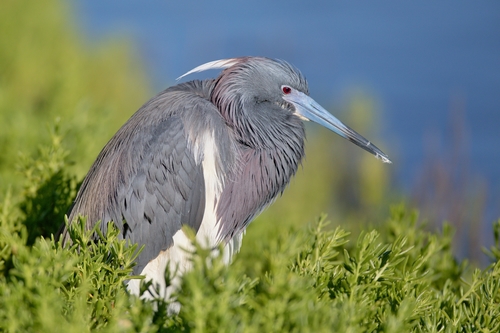
Tricolored Heron
Egretta tricolor
Meet the 'Lady of the Waters,' a slender and elegant hunter famous for its high-energy fishing dance. With its unique white belly and graceful profile, the Tricolored Heron is a master of the coastal wetlands.
Quick Identification
Size
Length: 24–30 in (60–76 cm); Wingspan: 36–38 in (91–96 cm); Weight: 11–15 oz (310–425 g)
Colors
Blue-gray upperparts, distinctive white belly and under-wing coverts, white vertical stripe on the neck, and yellowish to blue bill.
Key Features
- Contrast between dark chest and bright white belly
- Extremely slender, 'snake-like' neck
- Long, thin yellowish bill that turns bright blue during breeding
- White stripe running down the center of the foreneck
When You’ll See Them
Sightings on EverydayEarth
Jul 20, 2026
A juvenile Tricolored Heron stands prominently in the foreground, looking around the muddy ground. Several white feathers are scattered across the scene, likely from nearby nesting waterbirds. The heron remains relatively still, showing off its long, slender bill and distinctive colorful plumage.
Jul 20, 2026
Several American Alligators are resting in the swampy water and on the muddy banks near a wooden boardwalk. A Tricolored Heron stands patiently at the water's edge on the right side of the frame, likely hunting for small fish or insects. A white wading bird is also visible in the distance on the left bank.
Jul 20, 2026
Two Tricolored Herons are perched on branches over the water. The bird in the center is actively preening its feathers, while a second heron on the far left shifts its weight and looks around.
Jul 19, 2026
A Tricolored Heron stands perfectly still on one leg on a muddy bank. As the camera zooms out, it reveals a wider view of the swampy shoreline where a Snowy Egret is foraging near the water's edge. Other wading birds can be seen further in the background near fallen logs.
Jul 19, 2026
A group of waterbirds is perched across the bare branches of a large tree. Four Anhingas are visible on the higher limbs; one in the center is actively preening its feathers. A Great Egret stands prominently on a lower branch, occasionally stretching its long neck, while a smaller Tricolored Heron perches just above it, looking out over the swamp.
Jul 17, 2026
A Snowy Egret forages along the muddy bank while a Tricolored Heron stands still in the shallow water, both likely hunting for small fish or crustaceans. In the deeper water in the background, an American Alligator floats near the reflection of a wooden walkway.
Behavior
Often referred to as the 'Lady of the Waters,' the Tricolored Heron is one of the most graceful and animated hunters in the heron family. Unlike the statuesque Great Blue Heron, this species is frequently on the move, utilizing a 'canopy' hunting style where it spreads its wings to create shade, drawing fish toward the shadow before striking with lightning speed.
They are generally more solitary than other egrets and herons when foraging, preferring to keep a respectful distance from others to avoid competition. In social settings, they are most active during the breeding season when they join mixed-species colonies. To humans, they appear wary but curious, often allowing a closer approach than other herons if the observer remains still and quiet.
EverydayEarth exclusive
Camera Tips
To capture high-quality footage of a Tricolored Heron, placement is your most critical factor. These birds are 'edge hunters,' meaning they prefer the transition zone where tall marsh grasses meet shallow water. Position your camera on a stake or low-profile mount just 12 to 18 inches above the water level. Angling the camera along the shoreline—rather than directly out toward open water—will keep the bird in the frame longer as it stalks its prey. If you are monitoring a backyard pond, place the camera near a flat 'landing stone' or a shallow shelf where the water is less than 4 inches deep.
Because the Tricolored Heron is a fast-moving hunter, you must prioritize trigger speed and frame rate. Set your camera to 'Burst Mode' to capture the moment of impact during a strike, or use 60fps video to see the incredible 'dancing' behavior they use to confuse fish. These birds are highly active during the golden hours of dawn and dusk; ensure your camera has a high-quality CMOS sensor to handle these low-light conditions without excessive grain or motion blur. If your camera allows for sensitivity adjustments, set the motion trigger to high, as their slender necks can sometimes fail to trigger less sensitive PIR sensors.
In coastal areas, pay close attention to the tides. Tricolored Herons follow the receding tide to find trapped fish in tide pools. Mounting your camera in a spot that is exposed at low tide but safe from flooding at high tide is the secret to getting 'the shot.' Do not use artificial lures or food; instead, ensure there is a clear, unobstructed flight path to a shallow wading area. If the bird feels the area is safe and provides good visibility for predators, it will return to the same hunting spot daily.
Similar Species
Species that look similar or are commonly confused with Tricolored Heron.
Little Blue Heron
Lacks the white belly of the Tricolored Heron and is a uniform dark blue as an adult.
Great Blue Heron
Much larger with a heavier bill and lacks the clean white underparts.
Snowy Egret
Entirely white plumage with 'golden slippers' (yellow feet), unlike the blue-gray Tricolored Heron.
Frequently Asked Questions
Record Tricolored Heron at your habitat
Connect a camera to start building your own species record — AI identifies every visitor automatically.