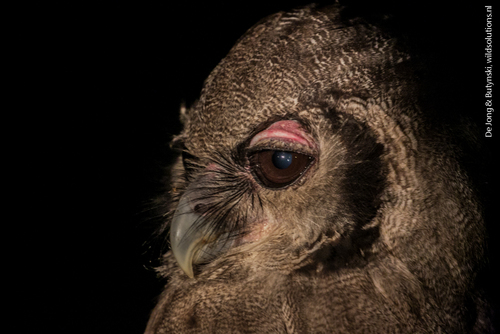
Verreaux's Eagle-Owl
Ketupa lactea
Africa's largest owl is a majestic grey giant known for its booming voice and unique pink eyelids. A master of the savanna night, this powerful predator is a bucket-list find for any backyard wildlife enthusiast.
Quick Identification
Size
Length: 58–66 cm (23–26 in); Wingspan: 140–164 cm (55–65 in); Weight: 1.6–3.1 kg (3.5–6.8 lb)
Colors
Uniformly pale grey plumage with fine dark wavy lines; pale grey facial disc with a thick black border; distinctive bubblegum-pink eyelids.
Key Features
- Distinctive pink eyelids visible when blinking or sleeping
- Massive size, being the largest owl in Africa
- Large pale facial disc with a bold black frame
- Prominent ear tufts and dark brown eyes
When You’ll See Them
Sightings on EverydayEarth
Jul 2, 2026
Two African Hawk-Eagles are perched on a thick branch in the early morning light, occasionally turning their heads to scan the surrounding woodland. The footage then transitions to a nighttime scene where a Verreaux's Eagle-Owl is seen standing on the ground, alert and looking around.
Jun 29, 2026
The video opens with a pair of African Hawk-Eagles perched side-by-side on a branch during the day, looking around their woodland habitat. The footage then cuts to a nighttime infrared scene showing a Verreaux's Eagle-Owl standing on the ground, blinking and observing its surroundings.
Jun 19, 2026
Two African Hawk-Eagles are perched together on a sturdy branch during the day, observing their surroundings in the woodland. The footage then switches to a nighttime scene where a large Verreaux's Eagle-Owl stands on the ground, its distinctive pink eyelids visible as it blinks.
Behavior
These owls are remarkably bold and exhibit a calm temperament, often remaining perched even when humans are nearby, provided they are at a safe height. They are highly intelligent and opportunistic, known to take over the abandoned stick nests of larger birds like vultures or Hamerkops rather than building their own. Their presence in an area is a sign of a healthy ecosystem with a robust supply of medium-sized mammals and birds.
EverydayEarth exclusive
Camera Tips
To capture this 'Giant of the Night' on a trail camera, you must focus on height and hydration. Because Verreaux's Eagle-Owls are large-bodied birds, they require significant water intake and enjoy bathing to keep their feathers in top condition. Positioning a camera near a permanent water trough or a large garden pond is your best bet. Set the camera at a low angle facing the water's edge, but ensure the field of view is wide enough to capture their impressive 5-foot wingspan as they descend.
If you are looking to capture roosting behavior, look for 'whitewash' (white droppings) or large grey pellets at the base of tall Acacia or Leadwood trees. Mount your camera on a neighboring tree or a high pole at a height of 10-15 feet, angled slightly downward toward a sturdy, horizontal branch. Use a high-speed trigger and a fast shutter setting; even though they are massive, their strike is incredibly quick. Because they are strictly nocturnal, a 'No-Glow' infrared flash is essential to avoid spooking the owl or causing 'white-out' on their pale grey feathers.
For the most engaging footage, use 'Hybrid Mode' to capture a high-resolution still followed by a 20-30 second video. This often captures the owl's unique 'grunting' call or the striking moment they blink, revealing those famous pink eyelids. During the dry season, water is the ultimate lure, but in the breeding season (which varies by region), focusing on established nest sites in large trees will provide the most consistent activity for your AI-powered camera.
Similar Species
Species that look similar or are commonly confused with Verreaux's Eagle-Owl.
Frequently Asked Questions
Record Verreaux's Eagle-Owl at your habitat
Connect a camera to start building your own species record — AI identifies every visitor automatically.