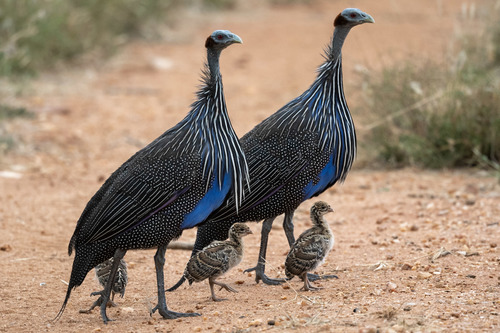
Vulturine Guineafowl
Acryllium vulturinum
With its striking cobalt blue plumage and distinct vulture-like head, the Vulturine Guineafowl is arguably the most stunning gamebird in the world. This social bird brings a touch of prehistoric elegance to the arid landscapes of East Africa.
Quick Identification
Size
Length: 61–71 cm (24–28 in); Weight: 1–1.6 kg (2.2–3.5 lbs)
Colors
Striking cobalt blue breast and neck; body is black with fine white spotting; bare blue-grey head with a distinctive chestnut patch on the nape; bright red eyes.
Key Features
- Long, lancet-shaped black and white hackles on the neck
- Vibrant cobalt blue chest plumage
- Unfeathered, vulture-like head and neck
- Large, gregarious social flocks
- Striking red irises
When You’ll See Them
Sightings on EverydayEarth
Jul 31, 2026
A Kirk's Dik-dik stands quietly in the shade of a tree on the left side of the frame. Meanwhile, a large flock of Vulturine Guineafowl emerges from the right, foraging through the tall, dry grass and moving across the background.
Jul 25, 2026
Four Vulturine Guineafowl are perched on the bare, skeletal branches of a tree during the low-light hours. They are largely stationary, likely roosting, though some minor head movements and shifts in posture are visible as they balance on the limbs.
Jul 3, 2026
A large flock of Vulturine Guineafowl has gathered at the edge of a water source. The birds are actively drinking, with many dipping their heads to the water while others stand alert on the dry, dusty bank.
Jul 3, 2026
A large flock of Vulturine Guineafowl has gathered at a muddy waterhole. Most of the birds are positioned along the bank, leaning down to drink while others stand alert, showcasing their brilliant blue and striped plumage.
May 26, 2026
Two Vulturine Guineafowls are foraging on a sunlit grassy hillside. One bird is perched prominently on a ridge near a large boulder, while a second individual is visible moving through the tall grass in the lower left of the frame.
May 7, 2026
Three Vulturine Guineafowl are observed foraging along a muddy riverbank. They move with characteristic jerky motions, pecking at the ground for food as they slowly traverse the scene from right to left.
Behavior
Vulturine Guineafowl are exceptionally social birds, often forming large groups known as "confusions" or flocks that can range from 20 to over 50 individuals. Unlike many other bird species, they maintain a complex multi-level social structure and are rarely seen alone. They spend the majority of their day on the ground, walking long distances in search of food, and are remarkably fast runners, often choosing to outpace predators on foot rather than taking to the air.
While they are generally shy and wary of human presence, they are highly vocal among themselves. Their communication consists of a variety of rhythmic clucking, piping, and metallic screeching sounds that help keep the flock together in dense scrub. At night, the entire group will fly up into the canopy of acacia or other tall trees to roost, protecting themselves from ground-based predators like leopards or caracals.
EverydayEarth exclusive
Camera Tips
To capture the best footage of Vulturine Guineafowl, camera placement is everything. Since these birds are strictly terrestrial during the day, you should mount your camera low to the ground, roughly 8 to 12 inches high. Angle the lens slightly upward or keep it level with their eye line to capture the incredible detail of their blue plumage and red eyes. Because they travel in large flocks, a wide-angle lens or a placement that overlooks a clearing is preferable; otherwise, you may only see a blur of legs as the group rushes past.
If you are looking to attract them to a specific frame, scattering a mixture of cracked corn, millet, or sunflower seeds can be very effective in areas where they are known to roam. These birds are also highly attracted to "dusting" areas where the soil is loose and dry. If you notice a patch of ground where the birds have been wallowing to clean their feathers, set your camera there. They are most active during the cooler hours of the morning and late afternoon, so ensure your camera’s trigger sensitivity is optimized for these low-light but high-activity windows.
In terms of technical settings, a fast shutter speed is vital because their head movements are incredibly rapid. If your AI camera supports video, set it to record 20-30 second clips; this allows you to capture their unique social hierarchy and the fascinating way they communicate through head-bobbing and vocalizing. During the peak of the dry season, placing your camera near a ground-level water source is a surefire way to get high-quality captures, as they will congregate there in the heat of the day.
Similar Species
Species that look similar or are commonly confused with Vulturine Guineafowl.
Frequently Asked Questions
Record Vulturine Guineafowl at your habitat
Connect a camera to start building your own species record — AI identifies every visitor automatically.