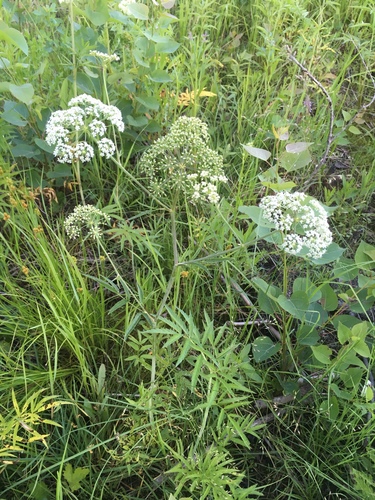
water hemlock
Cicuta maculata
Often called the most 'violently toxic' plant in North America, water hemlock is a tall, striking wetland perennial that demands respect and a long-distance lens.
Quick Identification
Size
3 to 8 feet (0.9 to 2.4 meters) tall with a spread of 1 to 3 feet (0.3 to 0.9 meters)
Colors
Bright green foliage, smooth stems with purple splotches or mottling, and clusters of tiny white flowers
Key Features
- Smooth stems with distinct purple spots or streaks
- Umbrella-shaped white flower clusters (umbels)
- Double-compound leaves with serrated edges
- Leaf veins that end in the notches between the leaf teeth
When You’ll See Them
Behavior
Despite its lethality to mammals, water hemlock is a hub of activity for the insect world. It serves as a vital nectar source for many beneficial insects, including predatory wasps, honeybees, and various species of butterflies. For humans, the 'behavior' of this plant is best observed from a distance; it is a master of disguise, often being mistaken for harmless members of the carrot family like wild parsnips or Queen Anne's Lace.
EverydayEarth exclusive
Camera Tips
When setting up a camera to document water hemlock, safety is the first priority. Ensure you are wearing gloves if you need to clear any surrounding brush, and never ingest any part of the plant. Because water hemlock is stationary, it is the perfect subject for a time-lapse sequence. Set your camera on a sturdy tripod or a low-mounted post near the water’s edge. A capture interval of one photo every 30 minutes during daylight hours over the course of a week in June can beautifully document the transition from tight green buds to explosive white umbels.
To capture the fine details needed for AI identification—specifically the purple mottling on the stem and the leaf venation—position your camera about 2 to 3 feet away from the main stalk. Use a side-angle to capture the profile of the 'umbrella' flowers against a darker background, like a forest edge, to make the white blooms pop. If your camera allows for macro settings, focus on the point where the leaf vein meets the notch of the serrated edge; this is a diagnostic feature that separates it from similar-looking species.
Don't just focus on the plant itself; use your camera to monitor the 'micro-wildlife' that visits. Water hemlock is a magnet for the Eastern Black Swallowtail butterfly, which uses the plant as a host. High-speed trigger settings or video mode can capture these vibrant pollinators against the stark white flowers. Avoid using heavy baits or lures that might attract curious pets or livestock to the area, as the plant is extremely dangerous to them if they decide to take a nibble of the surrounding vegetation.
Similar Species
Species that look similar or are commonly confused with water hemlock.
Frequently Asked Questions
Record water hemlock at your habitat
Connect a camera to start building your own species record — AI identifies every visitor automatically.