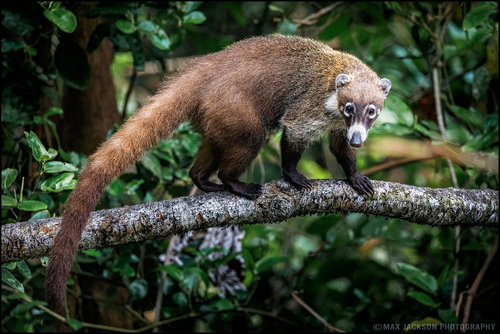
White-nosed Coati
Nasua narica
Often called the 'Southwestern Raccoon,' the White-nosed Coati is a social, high-energy climber with an unmistakable long snout and an even longer tail.
Quick Identification
Size
Body length of 110 cm (3.6 ft); weight ranging from 3.1–9 kg (6.8–20 lb)
Colors
Grizzled brownish-gray or reddish fur with a white band around the nose and white spots near the eyes
Key Features
- Long, slender tail held vertically while walking
- Distinctive white muzzle and 'mask' around eyes
- Extremely flexible, upward-turned snout
- Long, curved claws designed for digging
- Social behavior involving large groups of females and young
When You’ll See Them
Behavior
White-nosed Coatis are fascinatingly social creatures, a rarity among the Procyonid family. While their cousins, the raccoons, are solitary and nocturnal, coatis are primarily diurnal and live in highly organized social groups called 'bands.' These bands, consisting of up to 30 females and their offspring, spend their days grooming one another and foraging across the forest floor in a coordinated fashion. Their communication is constant, involving a series of chirps, snorts, and tail-waving signals that keep the group together.
Adult males are the outliers of the species, leading solitary lives for most of the year. This solitary nature earned them the Spanish nickname 'gato solo.' They only interact with the bands during the breeding season. Coatis are remarkably agile, equally at home digging in the dirt for grubs or leaping through the canopy to forage for fruit or escape predators like jaguars or eagles.
EverydayEarth exclusive
Camera Tips
To capture the best footage of White-nosed Coatis, focus on their travel corridors. Unlike many mammals that hug the brush, coatis often walk right down the center of forest trails or dry creek beds. Position your camera low to the ground—about 12 to 15 inches high—and angled slightly upward. This 'coati-eye view' captures their incredibly expressive faces and flexible snouts as they sniff the ground. Because they travel in bands, always set your camera to 'Video Mode' or a high-count 'Burst Mode' (3-5 photos per trigger). If you only take one photo, you’ll likely catch the lead female and miss the twenty youngsters trailing behind her.
Coatis are highly motivated by scent. While we don't recommend feeding them, you can encourage them to linger in front of the lens by using a 'scent station.' A small amount of vanilla extract or anise oil applied to a porous rock or log can trigger their intense curiosity. They will spend several minutes sniffing and scratching at the scent, providing you with excellent close-up footage of their unique grooming and foraging behaviors. Be sure to use a camera with a fast trigger speed, as they can be surprisingly quick when they aren't distracted by food.
In backyard settings, coatis are often drawn to water features. A ground-level birdbath or a small pond is a magnet for a thirsty band during the heat of the day. Position your camera to face the water source from the north to ensure the sun is behind the camera, highlighting the grizzled texture of their fur without blowing out the highlights on their white facial markings. Since they are active during the day, you don't need to worry as much about 'white-out' from infrared flashes, but high-quality glass lenses will help capture the subtle color variations in their coats.
Similar Species
Species that look similar or are commonly confused with White-nosed Coati.
Frequently Asked Questions
Record White-nosed Coati at your habitat
Connect a camera to start building your own species record — AI identifies every visitor automatically.