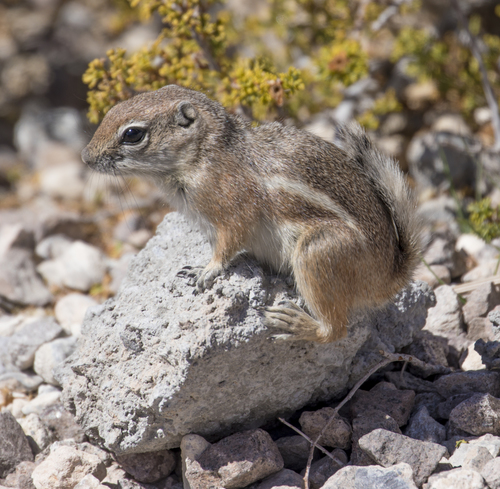
White-tailed Antelope Squirrel
Ammospermophilus leucurus
A pint-sized powerhouse of the American Southwest, the White-tailed Antelope Squirrel is a desert sprinter that defies the midday heat with a flash of its iconic tail.
Quick Identification
Size
Length: 7.5 to 9.4 inches (19 to 24 cm); Weight: 3 to 5.5 ounces (85 to 156 grams)
Colors
Grayish-brown or tan upper body with a single, distinct white stripe on each side; the underside of the body is creamy white, and the underside of the tail is a brilliant, flashing white.
Key Features
- Single white stripe on each side of the body running shoulder to rump
- Tail held curled over the back, revealing a bright white underside
- Lacks facial stripes common in similar-looking chipmunks
- Small, rounded ears and a stocky, ground-dwelling build
When You’ll See Them
Behavior
The White-tailed Antelope Squirrel is a desert specialist, famous for its high tolerance for extreme heat. Unlike many other desert creatures that retreat during the hottest part of the day, these energetic rodents are frequently seen darting across open ground even when temperatures soar. They manage this by a behavior known as 'heat dumping'—periodically retreating to a burrow or spreading their bodies flat against cool, shaded soil to transfer excess body heat to the earth before resuming their frantic foraging.
These squirrels are generally solitary but may live in loose colonies where several individuals share overlapping territories. They communicate through high-pitched, bird-like whistles and utilize their tails as a signaling device. When running, they flip their tail over their back, exposing the bright white underside; this may serve as a 'distraction display' for predators or a warning signal to other squirrels. Despite their small size, they are remarkably bold and curious, often becoming accustomed to human presence in desert-edge neighborhoods.
EverydayEarth exclusive
Camera Tips
Capturing high-quality footage of these lightning-fast squirrels requires a camera with a very rapid trigger speed. Because they are strictly ground-dwellers, place your camera very low—ideally just 4 to 6 inches off the ground. Aiming the lens at a flat rock or a cleared patch of sandy soil near the base of a creosote bush or prickly pear cactus is ideal, as these are natural 'pit stops' where the squirrels frequently pause to scan for danger.
To encourage them to linger long enough for a clear photo, use a natural lure like a small pile of unsalted sunflower seeds or a piece of cactus fruit. Secure the bait near a textured log or a colorful rock to create a more professional, visually interesting composition. Since they are active during the brightest parts of the day, ensure your camera is positioned to avoid direct lens flare from the desert sun; north-facing setups usually provide the most consistent lighting and prevent 'white-out' from overexposure on their pale fur.
Adjust your camera settings to a high-speed 'Burst Mode' or set it to record short video clips (10-15 seconds). These squirrels move with a jerky, stop-and-start motion, and a single photo often catches only a blurred tail. Using a high-resolution video setting allows you to observe their unique 'heat dumping' behavior or the way they twitch their tail over their back. During the spring months, look for signs of burrow entrances near rocky outcroppings and place your camera several feet back to capture the young pups emerging for the first time.
Similar Species
Species that look similar or are commonly confused with White-tailed Antelope Squirrel.
Frequently Asked Questions
Record White-tailed Antelope Squirrel at your habitat
Connect a camera to start building your own species record — AI identifies every visitor automatically.