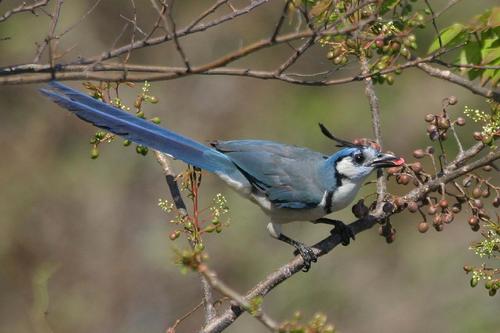
White-throated Magpie-Jay
Cyanocorax formosus
Boasting a magnificent curled crest and a sweeping tail, the White-throated Magpie-Jay is the charismatic monarch of the Central American dry forest. These intelligent, social birds are as famous for their bold personalities as they are for their striking blue and white plumage.
Quick Identification
Size
Length: 46–56 cm (18–22 in); Weight: 205–213 g (7.2–7.5 oz); nearly half the total length is comprised of the tail.
Colors
Brilliant blue upperparts and wings; creamy white underparts; white face and throat bordered by a thin black 'necklace'; striking black crest feathers.
Key Features
- Extremely long, graduated blue tail with white tips
- Prominent crest of forward-curling black feathers on the head
- Thin black line curving under the throat and behind the eye
- Large, bold silhouette with a heavy bill
When You’ll See Them
Sightings on EverydayEarth
Jul 26, 2026
A Scarlet Macaw is perched on a large tree limb on the right, observing its surroundings. To the left, another Scarlet Macaw is actively feeding at a tray mounted on a branch. A White-throated Magpie-Jay flies in and lands on the edge of the feeder tray, momentarily sharing the space with the feeding macaw.
Jun 25, 2026
A White-throated Magpie-Jay is seen feeding on a tray of fruit. It briefly flies off before another (or the same) individual returns, landing on the edge of the swaying feeder. The bird's striking blue plumage and elegant long tail are clearly visible against the leafy background.
Behavior
Known for their boldness, they are the self-appointed sentinels of the forest. They will loudly 'mob' hawks, owls, or even humans who venture too close to their territory, letting out a series of raucous, scolding shrieks. Despite their noisy reputation, they also possess a quieter side, capable of intricate warbles, whistles, and even mimicking the sounds of other birds or environmental noises.
EverydayEarth exclusive
Camera Tips
These birds are naturally curious and highly motivated by food. A platform feeder is far more effective than a hanging tube feeder for this species. Lure them in with native fruits like papaya, bananas, or halved oranges. If you want to see their intelligence in action, try using a suet cage or a puzzle feeder; they will often spend several minutes working to extract the food, giving your AI camera plenty of time to capture high-quality video. They are also very fond of water, so placing your camera near a large, sturdy birdbath can result in excellent 'action' shots of them splashing.
Because they are gregarious, one magpie-jay usually means five more are following. Set your camera's 'retrigger' time to the minimum setting or use a 'Burst Mode' to capture the social dynamics of the flock. You’ll often catch them 'allopreening' (grooming each other) or engaging in ritualized food sharing. During the dry season, they are particularly active around water sources, making this the best time of year for high-traffic camera captures. Avoid placing the camera where the afternoon sun will hit the lens directly, as their white underparts can easily 'blow out' and lose detail in harsh lighting.
Similar Species
Species that look similar or are commonly confused with White-throated Magpie-Jay.
Frequently Asked Questions
Record White-throated Magpie-Jay at your habitat
Connect a camera to start building your own species record — AI identifies every visitor automatically.