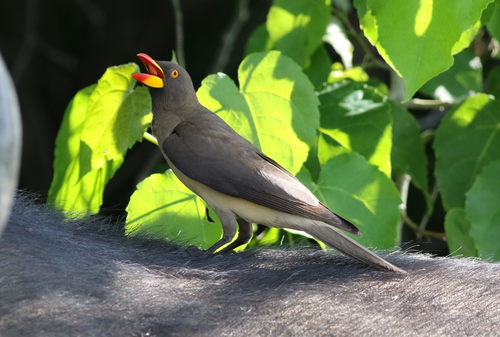
Yellow-billed Oxpecker
Buphagus africanus
Meet the savanna’s most diligent groomer. The Yellow-billed Oxpecker spends its life hitched to Africa's giants, providing a vital cleaning service in exchange for a steady meal.
Quick Identification
Size
Length: 19–22 cm (7.5–8.7 in); Weight: 57–71 g (2.0–2.5 oz); Wingspan: approx 35 cm (13.8 in)
Colors
Olive-brown upperparts and pale buff underparts; bill is bright yellow at the base with a red tip; eyes are red with no eye-ring
Key Features
- Yellow bill with a distinct red tip
- Pale buff-colored belly and rump
- Strong, curved claws for gripping animal hides
- Broad, flattened bill for 'scissoring' through fur
When You’ll See Them
Sightings on EverydayEarth
Jun 28, 2026
A large hippopotamus is resting on the dry ground near tall grass. Several oxpeckers are perched on its face and back, performing their symbiotic role of grooming the hippo's skin for parasites. The hippo remains mostly still, occasionally twitching its ears.
Jun 25, 2026
A large Common Hippopotamus is seen from behind, standing stationary on a group of flat rocks at the edge of a river. Several oxpeckers are perched on its back, actively moving around and grooming the hippo's skin for parasites. In the lower-left foreground, several other hippos are submerged in the murky water, with only their heads and ears occasionally breaking the surface.
Jun 14, 2026
A group of hippos rests in a sunlit river during the early morning. While several adults remain partially submerged with only their heads and backs breaking the surface, one smaller hippo stands on a cluster of rocks in the center of the water. A Yellow-billed Oxpecker is perched on the standing hippo's back, a common symbiotic behavior where the bird feeds on parasites.
Behavior
The Yellow-billed Oxpecker is famously known for its mutualistic relationship with Africa's large herbivores. You’ll rarely find these birds on the ground; instead, they spend almost their entire day perched on the backs and sides of buffalo, rhinos, and giraffes. They serve as a natural cleaning service, scissoring through thick fur to remove parasites, though they are also known to keep wounds open to feed on blood—a behavior that leans toward parasitism.
Socially, they are gregarious birds, often seen in small groups of 2 to 6 individuals on a single host. They are highly vocal, emitting a characteristic hissing 'krisss-krisss' sound that acts as an early warning system for their hosts. When a predator approaches, the oxpeckers fly upward and call out, alerting the mammal to potential danger before it’s even visible to the animal itself.
EverydayEarth exclusive
Camera Tips
Capturing the Yellow-billed Oxpecker on camera requires a strategy focused on their hosts rather than the birds themselves. Since these birds spend the vast majority of their time on large mammals, your AI-powered camera should be positioned near waterholes, salt licks, or livestock rubbing posts. Set your camera at a height of about 3 to 4 feet (1 meter), angled slightly upward. This positioning allows you to capture the sides and backs of visiting buffalo or cattle where the birds are most active.
Avoid using traditional bird feeders, as Yellow-billed Oxpeckers are specialized feeders and will not be attracted to seeds or suet. If you live on a farm or ranch, placing a camera near a cattle trough is your best bet. High-speed shutter settings or a 'burst' mode are essential, as these birds move quickly across the host’s body with a jerky, hitching motion. Because they are most active during the day, ensure your camera is positioned to avoid direct lens flare from the midday sun, ideally facing north or south.
To get the best shots of their unique feeding behavior, look for 'cleaning stations.' If you notice a particular tree or fence line where cattle or game animals tend to congregate to rest, focus your camera there. The birds will often hop off the host to preen or interact with each other in the nearby branches before returning to their 'mobile buffet.' Using a camera with a fast trigger speed (0.2s or less) is vital because oxpeckers are easily spooked by the sudden movements of their hosts.
Seasonal considerations are also important; during the rainy season, hosts may disperse, making the birds harder to pin down. Focus your efforts during the dry season when animals are forced to visit specific water sources daily. If your AI camera supports bird detection, ensure it is calibrated for small, fast-moving objects against the larger, slower background of a mammal's hide.
Similar Species
Species that look similar or are commonly confused with Yellow-billed Oxpecker.
Frequently Asked Questions
Record Yellow-billed Oxpecker at your habitat
Connect a camera to start building your own species record — AI identifies every visitor automatically.