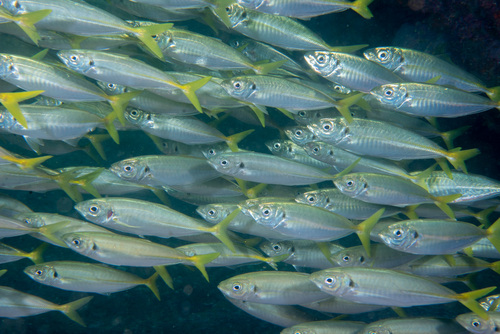
Yellowtail Scad
Trachurus novaezelandiae
A flash of gold in the coastal blue, the Yellowtail Scad is the energetic heartbeat of the reef. Known as 'Yakkas' to locals, these shimmering schoolers are a delight for underwater observers and a vital part of the marine ecosystem.
Quick Identification
Size
Typically 20–35 cm (8–14 in) in length; can reach up to 50 cm (20 in).
Colors
Iridescent greenish-blue or olive on the back with silver-white flanks; distinctive bright yellow to golden tail fin and a small dark spot on the gill cover.
Key Features
- Vibrant yellow tail fin
- Small black spot on the edge of the gill cover
- Row of sharp, bony scales (scutes) along the lateral line
- Slender, streamlined torpedo-shaped body
When You’ll See Them
Behavior
Yellowtail Scad, colloquially known as 'Yakkas' in Australia, are highly social and energetic schooling fish. They move in large, synchronized groups that can number in the thousands, creating a shimmering 'bait ball' effect that serves as a collective defense against predators. They are exceptionally fast swimmers, utilizing their streamlined bodies to dart through the water column in search of food or to evade larger fish like Kingfish and Salmon.
While they are pelagic by nature, they are frequently found congregating around structure. In suburban bays and coastal areas, they are a fixture around jetty pylons, pier supports, and rocky reef edges. They are curious but cautious; they will often investigate a new object in the water, like an underwater camera, but will scatter instantly if they perceive a sudden threat. Their behavior is heavily influenced by the tide and light, moving closer to the surface or into shallower water during the transition periods of dawn and dusk.
EverydayEarth exclusive
Camera Tips
Capturing the Yellowtail Scad requires an underwater setup, such as a waterproof action camera or a specialized submersible trail camera. For the best results in a 'backyard' coastal setting, mount your camera to a jetty pylon or a weighted tripod placed on the sandy bottom near a reef edge. Aim the camera horizontally or slightly upward toward the surface; this 'silhouetting' technique makes it easier for the AI to identify the species by its distinct streamlined profile and yellow tail against the lighter surface water.
To ensure you get plenty of footage, use a burley cage or a 'chum' bag. Fill it with minced fish or breadcrumbs and hang it approximately 1-2 meters in front of the lens. The scent will quickly draw in a school of Scad, and they will often stay in front of the camera for extended periods as they pick at the particles. Make sure the bait bag is securely weighted so it doesn't swing into the lens and obscure the view.
Lighting is your biggest challenge underwater. While the Scad are active during the day, the best 'golden hour' shots happen at dawn and dusk. If your camera supports it, use a high frame rate (60fps or higher) to capture their rapid, jerky movements without blur. In deeper or murkier water, a small underwater LED light can help pop the yellow color of their tails, but avoid pointing the light directly at the fish, as the reflection off their silver scales can cause overexposure. Instead, angle the light from the side to highlight their texture and the row of scutes along their flanks.
Similar Species
Species that look similar or are commonly confused with Yellowtail Scad.
Frequently Asked Questions
Record Yellowtail Scad at your habitat
Connect a camera to start building your own species record — AI identifies every visitor automatically.