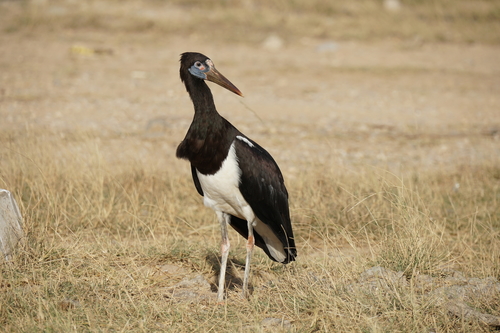
Abdim's Stork
Birds Daytime

Abdim's Stork

Ciconia abdimii

Meet the 'Rain Bird,' the world's smallest stork and a beloved symbol of coming storms across Africa. With its iridescent black wings and bright white belly, this social traveler is a master of the savanna.

0 Sightings
0 Habitats

Quick Identification

straighten

Size

Length: 73–80 cm (29–31 in); Wingspan: 140–155 cm (55–61 in); Weight: 1–1.5 kg (2.2–3.3 lbs)

palette

Colors

Shimmering black plumage with purple and green iridescence; distinctive white belly, breast, and under-tail; blue facial skin with a red patch near the eyes and bill.

visibility

Key Features

  • Smallest stork species in the world
  • Glossy black upperparts with a bright white belly
  • Blue and red bare facial skin
  • Greenish-grey legs with pinkish 'knees' and feet
add_a_photo
Is this an Abdim's Stork?

Drop a photo or video, or paste from clipboard

When You’ll See Them

schedule
Activity pattern Active during the day
brightness_5
Peak hours 8-11 AM, 3-6 PM
calendar_month
Season November-March (Southern Africa), May-August (East/North Africa)
restaurant
Diet Primarily insectivorous; they specialize in swarming insects like locusts, grasshoppers, and crickets. They also eat armyworms, caterpillars, beetles, and occasionally frogs or mice.
park
Habitat Open grasslands, savannas, pastures, and cultivated fields. Often found near human settlements and temporary rain pools.

public Geographic range

Where Does the Abdim's Stork Live?

The Abdim's Stork is a native of the African continent and the southwestern tip of the Arabian Peninsula. It breeds in the northern semi-arid regions from Senegal across to Ethiopia and Yemen, and then performs a massive intra-African migration to spend the non-breeding season in the grasslands of East and Southern Africa. This migratory path ensures they are always following the 'green belt' created by seasonal rains.

Basemap © OpenStreetMap contributors

10 Countries
Migratory Status
Least Concern Conservation
ZA South Africa ET Ethiopia Sudan KE Kenya Yemen NG Nigeria TZ Tanzania ZW Zimbabwe NA Namibia SN Senegal
eco
iNaturalist / Verified observation data
View on iNaturalist open_in_new

Explore more Birds arrow_forward

Behavior

The Abdim's Stork is a highly gregarious bird, famous for its massive migratory flocks that can number in the thousands. Known colloquially as the 'Rain Bird' across much of Africa, these storks are celebrated as harbingers of the wet season because they follow rain fronts to exploit the sudden emergence of insects. They are remarkably comfortable around humans, often nesting on the roofs of huts or in trees within busy villages, where they are protected by local traditions as symbols of good luck.

On the ground, they are active foragers, walking with a steady gait while scanning the grass for movement. Unlike many other storks that rely on wetlands, Abdim's Storks are perfectly at home in dry savannas and agricultural fields. They communicate through bill-clattering, especially when greeting a mate at the nest, creating a rhythmic wooden sound that is characteristic of the Ciconiidae family.

photo_camera EverydayEarth exclusive

Camera Tips

To capture the best footage of Abdim's Stork, focus your camera on wide-open lawn or pasture areas, especially just after a rainstorm. These birds are ground-hunters that prefer short grass where they can easily spot insects. Mount your camera at a low height—roughly 18 to 24 inches—and angle it slightly upward. This 'low-angle' perspective captures their elegant gait and the striking contrast of their white underparts against their dark wings.

Because of their dark, iridescent feathers, Abdim's Storks can easily appear as silhouettes in harsh light. Position your camera so that the morning sun is at the camera's back; this 'front-lighting' is essential to reveal the beautiful purple and green sheen on their plumage and the vivid blue skin on their faces. If you are using an AI-powered camera like those from EverydayEarth, ensure the 'Bird' detection is prioritized, as their movement can be slower and more deliberate than smaller songbirds.

If you live on a farm or have a large backyard, you can attract them by keeping a patch of grass mowed short during the rainy season. They are naturally attracted to livestock as well, as grazing animals flush out the insects the storks love to eat. Setting up a camera near a shallow birdbath or a temporary puddle after a storm is also a winning strategy, as they frequently stop to drink and preen their feathers after a morning of foraging.

Frequently Asked Questions

Abdim's Storks are strictly diurnal. They are most active during the mid-morning and late afternoon when insects are most mobile. They typically spend the hottest part of the midday soaring on thermals to conserve energy.
The best way to attract Abdim's Stork is to maintain a short-grass environment and avoid using pesticides. They are drawn to gardens with high insect populations, especially grasshoppers. They are also attracted to large, shallow water sources for drinking and bathing during dry spells.
They are primarily insectivores. Their favorite meals include locusts, grasshoppers, and armyworms, making them incredibly beneficial to farmers. They will also opportunistically eat small reptiles, amphibians, and mice.
Yes, they are quite common in suburban areas that border open fields or parks. Unlike many shy wildlife species, Abdim's Storks are very tolerant of human activity and frequently forage in backyard gardens and school sports fields.
Abdim's Stork is significantly smaller than the Black Stork. The most reliable way to tell them apart is the belly: Abdim's has a clean white belly and chest, while the Black Stork's white area is limited to the lower belly and under-tail. Additionally, Abdim's has blue facial skin, which the Black Stork lacks.

Record Abdim's Stork at your habitat

Connect a camera to start building your own species record — AI identifies every visitor automatically.

Join free Identify a photo