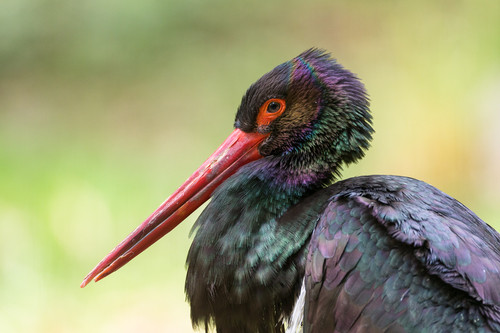
Black Stork
Ciconia nigra
A master of the deep woods, the Black Stork is the shy, iridescent cousin of the common White Stork. With its vibrant red bill and shimmering dark plumage, this 'forest ghost' is one of the most rewarding sightings for any wildlife enthusiast.
Quick Identification
Size
95–100 cm (37–39 in) in length; 145–155 cm (57–61 in) wingspan; weight 3 kg (6.6 lbs)
Colors
Glossy black plumage with purple and green iridescence; white breast and belly; bright red bill, legs, and orbital ring
Key Features
- Iridescent black plumage with a sharp white 'V' on the belly
- Long, pointed bright red beak and matching spindly legs
- Secretive, solitary behavior compared to the social White Stork
- Broad wings with deep finger-like primary feathers
When You’ll See Them
Geographic range
Where Does the Black Stork Live?
The Black Stork is a wide-ranging inhabitant of the Old World, with a native breeding range that spans from the Iberian Peninsula across Central and Eastern Europe into Russia and all the way to the Pacific coast of China. Most of these Palearctic populations are highly migratory, spending the winter months in the lush tropical wetlands of Sub-Saharan Africa or the Indian subcontinent. A distinct, non-migratory population is also found year-round in Southern Africa, specifically throughout South Africa, Namibia, and Zimbabwe.
Basemap © OpenStreetMap contributors
Behavior
Unlike its more famous relative, the White Stork, the Black Stork is a shy and reclusive 'forest phantom.' It avoids human settlements, choosing instead to lead a solitary life tucked away in ancient, undisturbed woodlands. They are known for their extreme wariness; a single human encounter near a nesting site can sometimes cause a pair to abandon their eggs. During the breeding season, they are territorial and prefer to keep several kilometers of forest between themselves and the next pair.
These birds are masterful flyers and long-distance migrants, often traveling between Europe and Sub-Saharan Africa twice a year. While they are usually silent, they can produce a variety of hisses and bill-clattering displays during courtship. Their foraging style is methodical; they wade slowly through shallow forest streams, often using their wings to create shade on the water to better spot the movement of fish and amphibians below.
EverydayEarth exclusive
Camera Tips
To capture the elusive Black Stork on camera, you must focus on 'stepping stone' water sources. Look for shallow, clear forest pools, narrow streams with low flow, or isolated marshy openings deep within the woods. These are the bird's primary foraging hubs. Place your camera approximately 12 to 18 inches off the ground, angled slightly upward to capture the full height of the stork. Because they are incredibly sensitive to human disturbance, use a camera with a completely silent shutter and a high-quality camouflage wrap to blend into the surrounding bark or foliage.
Success with this species requires patience and minimal intervention. Set up your camera at least two weeks before you expect the birds to arrive, as they are suspicious of new objects in their territory. Avoid visiting the site to check cards or batteries more than once every few weeks. If you must check the camera, do so during the middle of the day when the birds are most likely to be soaring or nesting elsewhere. Use a high trigger speed (0.5 seconds or less) to catch them as they strike at prey in the water.
Lighting is the most critical factor for showcasing the Black Stork's true beauty. Their plumage isn't just black—it's a spectrum of iridescent greens, purples, and coppers. Position your camera facing North (if in the Northern Hemisphere) so the sun remains behind the lens; this direct morning or afternoon light will hit the feathers and reveal the shimmer that is lost in the shade. High-resolution video settings are often better than photos for this species, as they capture the slow, graceful 'dancing' movements the birds make while hunting.
Similar Species
Species that look similar or are commonly confused with Black Stork.
Frequently Asked Questions
Record Black Stork at your habitat
Connect a camera to start building your own species record — AI identifies every visitor automatically.