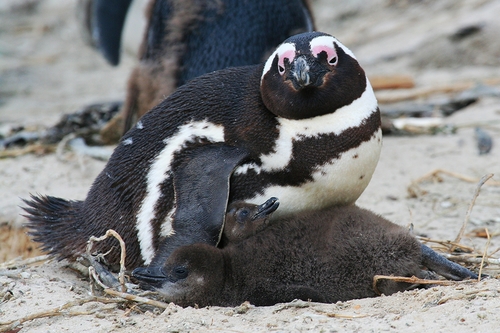
African Penguin
Spheniscus demersus
The only penguin species native to Africa, these 'tuxedoed' coastal residents are as famous for their donkey-like bray as they are for their resilient spirit and unique belly spots.
Quick Identification
Size
60–70 cm (24–28 in) tall; 2.2–3.5 kg (4.9–7.7 lb)
Colors
Black back and flippers with white underparts; black U-shaped band across the chest; pink skin patches above eyes.
Key Features
- Pink salt-excreting glands above eyes
- Single black horseshoe-shaped chest band
- Unique black spotting pattern on the belly
- Black facial mask with a white border
When You’ll See Them
Geographic range
Where Does the African Penguin Live?
The African Penguin is the only penguin species found on the African continent, natively inhabiting the southwestern coast. Its range extends from the central coast of Namibia down to Algoa Bay near Port Elizabeth in South Africa. While they primarily nest on offshore islands to avoid land-based predators, famous mainland colonies exist in places like Boulders Beach and Stony Point, where they live right on the edge of suburban areas.
Basemap © OpenStreetMap contributors
Behavior
African Penguins are highly social and colonial birds known for their charismatic waddle on land and incredible agility in the water. They are often called 'jackass penguins' due to their loud, donkey-like braying, which they use to communicate within the colony and establish nesting territories. They are monogamous and typically return to the same mate and nesting site year after year, showing a high degree of site fidelity.
During the day, they are often seen 'rafting' in groups offshore or sunning themselves on rocks. When breeding, they spend significant time guarding their nests, which are often built in burrows, under bushes, or even in man-made nesting boxes. While they are wild animals, some populations have become habituated to human presence in coastal towns, though they remain protective of their personal space.
EverydayEarth exclusive
Camera Tips
For those lucky enough to live in South African coastal enclaves like Simon's Town, African Penguins can be remarkably easy to capture on camera. The most important tip is placement height: set your camera very low, roughly 10-15 inches (25-40 cm) off the ground. This eye-level perspective captures their unique facial expressions and waddling movement much better than a high angle. Focus your camera on established 'penguin paths'—well-worn tracks through garden vegetation or sandy gaps between rocks that lead to the ocean.
Timing is everything with these birds. Program your camera to be most sensitive during the 'commute' times: just after sunrise when the colony heads out to sea, and late afternoon when they return with full bellies. Because they spend a lot of time in their burrows or under bushes during the heat of the day, a camera placed near a shaded nesting area can capture fascinating social interactions. However, avoid placing cameras directly inside a nesting burrow, as this can cause significant stress to the birds.
Use a camera with a fast trigger speed (0.3s or less) to catch them as they move quickly through the frame. Since penguins are active socially even after dark, ensure your camera uses 'No-Glow' or invisible black IR flash. Standard white flashes or even 'Low-Glow' red IR can startle them and disrupt their night vision. If you are using a camera in a garden setting, no bait is needed—they are strictly fish-eaters and won't be attracted to birdseed or fruit. Instead, focus on providing a clear line of sight to their natural transit routes.
Similar Species
Species that look similar or are commonly confused with African Penguin.
Frequently Asked Questions
Record African Penguin at your habitat
Connect a camera to start building your own species record — AI identifies every visitor automatically.