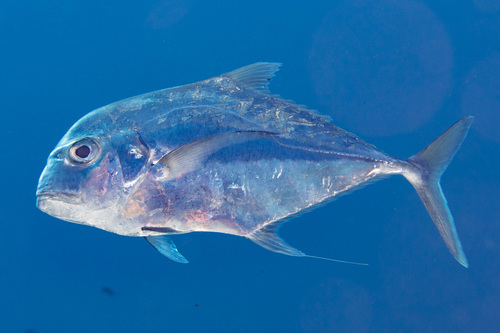
African Pompano
Alectis ciliaris
The African Pompano is a shimmering ghost of the tropical reefs, recognizable by its steep profile and brilliant silver armor. From its jellyfish-mimicking youth to its powerful adult form, it is one of the most striking members of the jack family.
Quick Identification
Size
Adults typically reach 60 to 90 cm (24–35 in), though they can grow up to 150 cm (59 in) and weigh over 22 kg (50 lbs).
Colors
Brilliant metallic silver with a faint bluish or greenish sheen on the back; juveniles may show dark vertical bands.
Key Features
- Extremely steep, concave head profile near the eyes
- Deeply compressed, diamond-shaped silver body
- Juveniles feature long, thread-like fin filaments several times their body length
When You’ll See Them
Geographic range
Where Does the African Pompano Live?
The African Pompano is a cosmopolitan species found in tropical and subtropical marine environments across the globe. In the Western Atlantic, they are found from the coastal waters of Massachusetts down to Brazil, while their Pacific range extends from the Gulf of California to Peru and across to the Hawaiian Islands. They are also prevalent throughout the Indo-Pacific region, spanning from the coast of East Africa to the waters of northern Australia and Japan.
Basemap © OpenStreetMap contributors
Behavior
The African Pompano is a powerful, fast-swimming predator belonging to the jack family. While many of its relatives travel in massive schools, adults of this species are more inclined to be solitary or live in small groups, often patrolling deep reefs, rocky outcrops, and shipwrecks. They are renowned among divers and fishers for their incredible strength and stamina, utilizing their flat, muscular bodies to create immense resistance when swimming against a current or a line.
One of the most fascinating aspects of their behavior is the dramatic change between life stages. As juveniles, they are pelagic, drifting through the open ocean near the surface. During this phase, their trailing fin filaments serve as a clever form of mimicry, likely imitating the stinging tentacles of jellyfish to ward off hungry predators. As they mature, they move toward the coast and lose these trailing threads, adopting the sleek, silver look of a high-speed hunter.
EverydayEarth exclusive
Camera Tips
Capturing the African Pompano on camera requires an underwater approach, making it an exciting challenge for those with coastal "backyards." The best setup involves a waterproof action camera or a stationary underwater housing mounted to a pier, dock piling, or a submerged reef structure. Because these fish are attracted to vertical relief, placing your camera near a piling in 15 to 30 feet of water is often more effective than placing it on a flat, sandy bottom.
Lighting is your biggest hurdle underwater. To capture the brilliant, mirror-like silver of the Pompano without it appearing as a washed-out white blob, position your camera so the sun is behind it. This illuminates the fish's side as it swims past. Early morning and late afternoon are the "golden hours" for underwater photography, as the angled light reduces the harshness of the reflection and brings out the subtle blue and green hues on the fish's dorsal side.
If you aren't seeing results, try using a "teaser." African Pompano are visual hunters and are often curious about shiny objects. Hanging a small, reflective metal spoon or a mirror-finished lure near the camera's field of view can entice them to come in for a closer look. For motion-activated setups, ensure your sensitivity is high, as these fish can appear and disappear from the frame in a matter of seconds. Using a frame rate of 60fps or higher will allow you to capture smooth footage of their powerful swimming motion.
Similar Species
Species that look similar or are commonly confused with African Pompano.
Frequently Asked Questions
Record African Pompano at your habitat
Connect a camera to start building your own species record — AI identifies every visitor automatically.