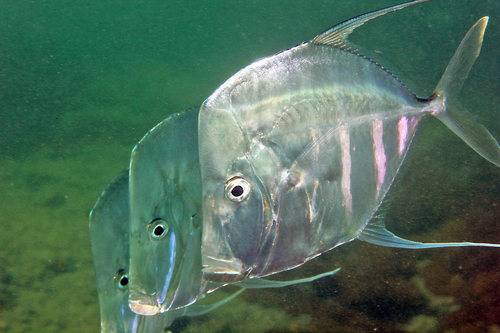
Lookdown
Selene vomer
With a body as thin as a cracker and a brilliant mirror-like finish, the Lookdown is one of the Atlantic's most striking coastal residents. This master of camouflage uses its 'vanishing' profile and steep, low-eyed face to navigate the surf and structure of the Western Atlantic.
Quick Identification
Size
Typically 25-35 cm (10-14 in) in length, though they can reach up to 48 cm (19 in) and weigh between 0.5-1.5 kg (1-3 lbs).
Colors
Brilliant metallic silver with a mirror-like iridescent sheen; juveniles may show faint yellow or golden vertical bars.
Key Features
- Extremely deep and laterally compressed 'pancake' body
- Blunt, steep forehead with eyes positioned very low on the head
- Long, trailing filaments on the second dorsal and anal fins in younger fish
- Small, deeply forked tail with a slender caudal peduncle
When You’ll See Them
Geographic range
Where Does the Lookdown Live?
The Lookdown is a native of the Western Atlantic Ocean, thriving in the coastal corridors of the Americas. Its range extends from the northern reaches of Canada and Maine down through the Gulf of Mexico and throughout the Caribbean. It is commonly found as far south as the coastal waters of Uruguay and Argentina, though it is most abundant in tropical and subtropical zones.
Basemap © OpenStreetMap contributors
Behavior
The Lookdown is a highly social and schooling species that relies on its unique physical build for survival. Their bodies are so thin that when viewed from the front, they almost disappear, providing a natural form of camouflage against predators. They are frequently observed in small to medium-sized schools hovering near the seafloor or around structure like bridge pilings and dock supports.
Known for their unusual 'grunting' sounds produced by grinding their teeth and amplifying the noise with their swim bladder, they are more communicative than many other coastal fish. While they are cautious, they are also curious and will often investigate slow-moving objects in the water. They are generally peaceful but are efficient, lightning-fast predators when targeting small prey.
EverydayEarth exclusive
Camera Tips
Capturing the Lookdown on camera requires a specialized approach since these fish are primarily found in coastal and estuarine environments. If your property includes a saltwater dock or pier, mounting an underwater action camera to a submerged piling is the most effective method. Position the camera at a depth of 3 to 6 feet, facing toward the open water but staying close to the structure, as Lookdowns often congregate around pilings to hunt for small crustaceans hiding in the barnacles.
Because the Lookdown has highly reflective, mirror-like skin, traditional white-light LEDs can cause significant 'hot spots' or overexposure in your footage. Instead, rely on natural ambient light during the day for the best color rendition. If you are filming at night, use a diffused green or blue light source; these wavelengths penetrate water more effectively and are less likely to spook the fish or bounce harshly off their metallic bodies. Aim your camera at a slight downward angle to fully capture their unique profile and the long, trailing filaments of their fins.
For the best results, set your camera to a high frame rate of at least 60fps. Lookdowns are surprisingly fast and agile; their thin profiles allow them to turn on a dime, effectively 'vanishing' from view when they face the lens directly. High-speed recording will help you catch the shimmering 'flash' they produce when they catch the sunlight. During late summer, you may find larger schools moving closer to shore, making this the peak time for coastal backyard observers to deploy their gear.
Similar Species
Species that look similar or are commonly confused with Lookdown.
Frequently Asked Questions
Record Lookdown at your habitat
Connect a camera to start building your own species record — AI identifies every visitor automatically.