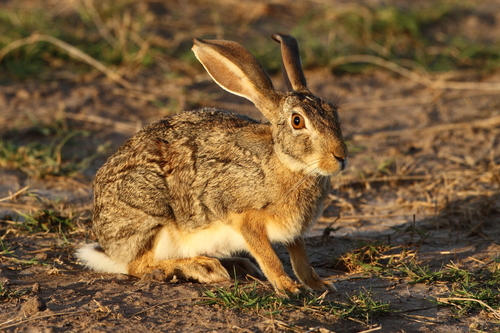
African Savanna Hare
Lepus microtis
Meet the African Savanna Hare, the nocturnal sprinter of the grasslands. With its oversized ears and incredible camouflage, this master of the night is a frequent visitor to backyard cameras across the continent.
Quick Identification
Size
Length: 41–58 cm (16–23 in); Weight: 1.5–3 kg (3.3–6.6 lb)
Colors
Grizzled buffy-brown or greyish upperparts with black flecks; white underparts; distinctive rufous (reddish-brown) patch on the back of the neck
Key Features
- Long ears with black tips and white margins
- Rufous-colored patch on the nape of the neck
- Grizzled brown-grey coat with a pure white belly
- Large hind legs adapted for high-speed sprinting
When You’ll See Them
Geographic range
Where Does the African Savanna Hare Live?
Native to the vast landscapes of the African continent, the African Savanna Hare is found throughout most of sub-Saharan Africa. Its core range extends from the Sahel region in West Africa across to Ethiopia and Kenya, and down through Central and Southern Africa to South Africa. While they are a staple of the savanna, they generally avoid the extremely arid deserts of the Sahara and the dense, humid rainforests of the Congo Basin.
Basemap © OpenStreetMap contributors
Behavior
The African Savanna Hare is a predominantly solitary and nocturnal mammal that spends its daylight hours hiding in 'forms'—shallow depressions in the ground or under dense vegetation. Unlike rabbits that live in burrows, these hares rely on their incredible camouflage and stillness to avoid detection. When a predator gets too close, they use their powerful hind legs to bolt at high speeds, often running in a zigzag pattern to confuse their pursuer.
While they are usually seen alone, they may congregate in small numbers where food is particularly abundant, such as in freshly burnt grasslands or lush agricultural fields. They are highly alert, using their large, rotatable ears to detect the slightest sound of approaching danger. Although they are not aggressive, they are known for their 'boxing' behavior during mating seasons, where individuals compete for dominance or territory.
EverydayEarth exclusive
Camera Tips
To capture the African Savanna Hare on camera, placement is everything. These hares travel along established 'game trails' through the grass or along the edges of thickets. Position your camera very low to the ground—no higher than 20 to 30 centimeters (8-12 inches)—to get a clear, eye-level shot. Point the camera toward a clearing or a patch of short grass near denser cover, as they often stop in these open spots to scan for predators.
Since this species is strictly nocturnal, your camera must have a high-quality infrared (IR) flash. White flash can startle them and cause them to flee, whereas 'no-glow' IR is much less intrusive. Set your camera to a fast trigger speed (0.3 seconds or less) because once a hare decides to move, it moves quickly. Using a 'burst mode' of 3 to 5 photos per trigger will help ensure you catch a clear image of the animal even if it is mid-stride.
If you are trying to attract them to a specific spot, fresh green grass, lucerne (alfalfa), or even a salt lick can be effective lures in drier environments. However, simply placing the camera near the boundary of a well-watered garden and the natural bush is often enough. Look for their distinctive droppings—small, round, compressed pellets of plant fiber—to identify high-traffic areas for your setup.
Similar Species
Species that look similar or are commonly confused with African Savanna Hare.
Frequently Asked Questions
Record African Savanna Hare at your habitat
Connect a camera to start building your own species record — AI identifies every visitor automatically.