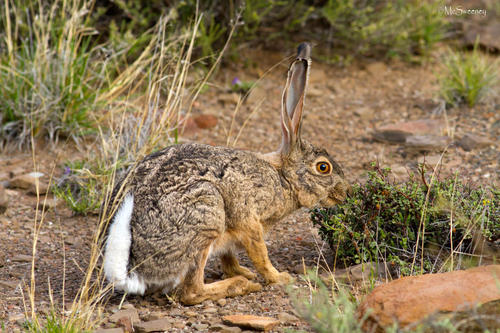
Cape Hare
Lepus capensis
The Cape Hare is a master of the open plains, using its incredible speed and oversized ears to stay one step ahead of predators across Africa and Asia.
Quick Identification
Size
Body length of 40-60 cm (16-24 inches); weight ranging from 1.5-4.5 kg (3.3-9.9 lbs)
Colors
Grizzled grey-brown or tawny upperparts with fine black ticking; crisp white underbelly and throat; distinctive black-tipped ears
Key Features
- Extraordinarily long ears with prominent black tips
- Large, amber eyes with a pale whitish ring
- Strong, elongated hind legs built for high-speed sprinting
- White tail with a broad black stripe along the upper surface
When You’ll See Them
Geographic range
Where Does the Cape Hare Live?
The Cape Hare is a remarkably adaptable survivor with a vast native range that spans the majority of the African continent, excluding only the densest tropical rainforests. Beyond Africa, its territory extends across the Arabian Peninsula and into the Middle East, reaching as far east as the Indian subcontinent. It is most commonly encountered in the arid and semi-arid regions of Southern and Eastern Africa, where it has successfully colonized both wild scrublands and the fringes of human agricultural developments.
Basemap © OpenStreetMap contributors
Behavior
The Cape Hare is a solitary and largely nocturnal mammal, though it is frequently seen during the twilight hours of dawn and dusk. Unlike rabbits, they do not live in burrows; instead, they rely on 'forms'—shallow depressions in the ground or under thickets where they lie perfectly still, using their cryptic coloration to blend into the soil and dry grass. When a predator gets too close, they utilize an explosive burst of speed, zigzagging at up to 60 km/h (37 mph) to evade capture.
While usually quiet and reclusive, their social behavior becomes more visible during the breeding season. You might witness the famous 'boxing' behavior, where individuals spar with their front paws; this is often a female rebuffing the advances of an overeager male. In areas near human habitation, they are generally shy but can become accustomed to quiet garden environments if there is plenty of cover and no roaming dogs.
EverydayEarth exclusive
Camera Tips
To capture high-quality footage of a Cape Hare, camera placement is everything. Because they are low-slung animals, mount your camera no higher than 30-40 cm (12-15 inches) off the ground. Angle the lens slightly upward if you are placing it on a slope. Position the camera along the edges of open clearings or along well-worn 'game paths' in tall grass, as hares prefer to navigate along established routes where they have a clear line of sight for escape.
Hares are notoriously skittish and have excellent hearing and vision. Use a camera with 'No-Glow' or 'Black' infrared LEDs. Standard 'Low-Glow' infrared can emit a faint red glimmer that may spook a Cape Hare, causing it to bolt before you get a good shot. Set your trigger speed to the fastest possible setting—ideally under 0.3 seconds—because these animals move with startling quickness once they decide to leave.
Since Cape Hares are most active during the night and twilight, focus on optimizing your night-vision settings. A 'High Sensitivity' PIR (Passive Infrared) sensor setting is recommended to detect their heat signature against the cooler night ground. If your camera supports it, use a 'Burst Mode' of 3-5 photos per trigger; the first photo might catch just a nose, but the subsequent shots often capture the full body as they hop past.
Avoid using traditional food baits, which often attract predators like jackals or domestic dogs that will scare the hares away. Instead, look for their 'forms'—those small depressions in the dirt—and place your camera several meters away facing the spot. If you have a vegetable garden, placing the camera near the perimeter where they might slip under a fence is a guaranteed way to see them in action during the night.
Similar Species
Species that look similar or are commonly confused with Cape Hare.
Frequently Asked Questions
Record Cape Hare at your habitat
Connect a camera to start building your own species record — AI identifies every visitor automatically.