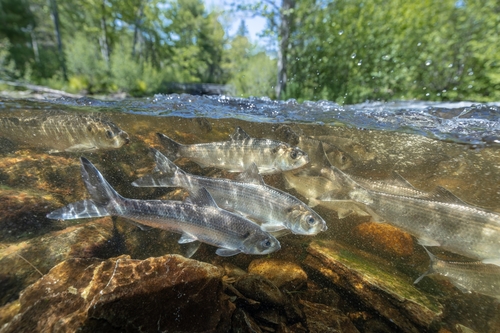
Alewife
Alosa pseudoharengus
Witness the silver tide of the Alewife, a resilient wanderer that bridges the gap between the deep ocean and our local freshwater streams. These shimmering schoolers are the heartbeat of the Atlantic coast's aquatic ecosystems.
Quick Identification
Size
Length: 10-14 inches (25-35 cm); Weight: 0.25-0.5 lbs (110-230 g)
Colors
Shimmering silver sides with a metallic sheen; greyish-green to bluish-violet back; small dark spot located just behind the gill cover.
Key Features
- Deeply forked tail fin
- Large eye with a diameter larger than the snout length
- Distinctive dark spot behind the gill cover (operculum)
- Saw-toothed scales along the belly known as scutes
When You’ll See Them
Geographic range
Where Does the Alewife Live?
Native to the Atlantic coast of North America, the Alewife’s range stretches from Newfoundland and the Gulf of St. Lawrence down to North Carolina. Beyond their coastal native home, they have become famously widespread as an introduced species in the Great Lakes and various inland Finger Lakes of New York. In these freshwater environments, they have established self-sustaining, landlocked populations that thrive far from the ocean.
Basemap © OpenStreetMap contributors
Behavior
Alewives are fascinating schooling fish known for their migratory lifestyle. They are primarily anadromous, meaning they spend most of their lives in the ocean but return to freshwater streams and ponds to spawn. During these runs, which typically occur in the spring, thousands of fish move in unison, creating a shimmering silver spectacle in shallow waters. In landlocked populations, such as those in the Great Lakes, they migrate from deep offshore waters to shallow nearshore areas.
In the water, they are constantly on the move, filter-feeding on microscopic organisms. They play a critical role in the food web, serving as a primary prey source for larger predators like salmon, trout, and striped bass. While they are sensitive to environmental changes and water temperature fluctuations, they are resilient enough to have established large, landlocked populations that significantly alter the ecosystems they inhabit.
EverydayEarth exclusive
Camera Tips
Capturing the silver flash of an Alewife run requires a specialized approach, as these fish are almost always submerged. For the best results, use an underwater action camera or a specialized submersible trail camera positioned in shallow, rocky stream beds or near fish ladders during the spring spawning season. Look for narrow 'pinch points' in the river where the current slows down, as Alewives tend to congregate there before making a concerted push upstream.
Lighting is your biggest challenge underwater. Position your camera facing away from the direct sun to avoid harsh glare on the water's surface, and try to utilize the natural light of midday when the sun is highest (typically 10 AM to 2 PM). If your camera allows, use a high frame rate setting (60fps or higher) to capture the rapid, darting movements of the school without motion blur. The silver scales reflect light easily, so even low-light conditions can sometimes yield ghostly, beautiful footage.
For those using traditional trail cameras above the water line, mount the camera on a sturdy stake or overhanging branch looking straight down into a shallow riffle. Since Alewives move in massive pulses, set your camera to 'Video Mode' with a short trigger interval to ensure you don't miss the peak of the school's passage. A polarizing filter held over the lens can also help cut through surface reflection if you are filming from above the water, allowing you to see the dark backs and silver sides of the fish below.
Similar Species
Species that look similar or are commonly confused with Alewife.
Frequently Asked Questions
Record Alewife at your habitat
Connect a camera to start building your own species record — AI identifies every visitor automatically.