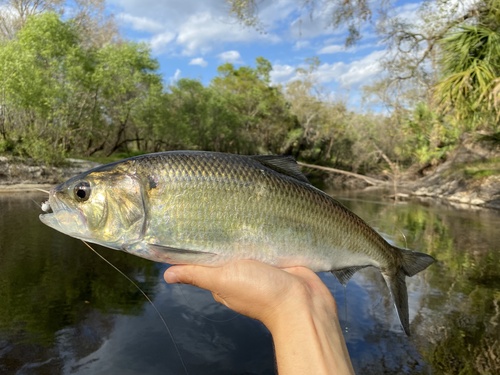
American Shad
Alosa sapidissima
Meet the 'Founding Fish' of the Americas. This silver-scaled marathon runner travels thousands of miles from the deep ocean to inland rivers to continue its ancient lifecycle.
Quick Identification
Size
20 to 30 inches (50–76 cm) in length; weighing between 3 and 8 lbs (1.4–3.6 kg)
Colors
Brilliant silvery-white sides with a metallic blue, green, or blackish back; a row of dark spots begins behind the gill cover
Key Features
- Distinctive saw-toothed scales (scutes) along the belly
- Deeply forked tail fin
- Large mouth with the upper jaw notched to receive the lower jaw
- Single dorsal fin located near the center of the back
When You’ll See Them
Geographic range
Where Does the American Shad Live?
This iconic migrant is native to the North American Atlantic coast, thriving from the frigid waters of Newfoundland and the St. Lawrence River down to the St. Johns River in Florida. In a remarkable feat of 19th-century conservation and engineering, they were successfully introduced to the Pacific coast, where they now range from Northern Mexico to the Bering Sea in Alaska. They are most frequently encountered in major river basins like the Delaware, Hudson, and Columbia during their spectacular spring spawning runs.
Basemap © OpenStreetMap contributors
Behavior
American Shad are the largest members of the herring family and are famously anadromous. They spend three to five years maturing in the Atlantic Ocean before embarking on a rigorous journey back to the freshwater rivers where they were born to spawn. During these migrations, they travel in massive, shimmering schools that can number in the thousands, providing a vital pulse of nutrients to river ecosystems and a feast for predators like eagles, bears, and striped bass.
Once they enter freshwater, American Shad largely cease feeding, relying on their stored body fat to fuel their upstream trek. They are known for their incredible swimming stamina and their ability to navigate complex river systems. While they were historically a staple food for Indigenous peoples and early American colonists—earning the moniker 'The Founding Fish'—modern populations are highly sensitive to river dams and water quality, making them an important indicator species for environmental health.
EverydayEarth exclusive
Camera Tips
To capture American Shad on camera, you must think like an angler and time your deployment with the spring 'shad run.' Because these are aquatic creatures, the most effective setup involves a waterproof action camera or a specialized underwater trail camera. Position your device in shallow river 'bottlenecks' or near gravel bars where the fish congregate to spawn. Look for 'fish ladders' at local dams, as these provide a guaranteed path where shad must pass through a narrow space, making them much easier to frame.
If you are placing a camera above the water looking down, a polarizing filter is non-negotiable. This will cut through the surface glare and allow you to see the dark silhouettes and silvery flashes of the school beneath. Aim your camera at a 45-degree angle to the current rather than directly across it; this captures the fish's profile as they fight their way upstream, providing a much more dramatic sense of their movement and effort.
Lighting is your best friend when dealing with silvery fish. The scales of the American Shad act like tiny mirrors, so the low-angle light of early morning or late afternoon can create a beautiful 'shimmer' effect on video. Avoid using a flash or bright white LEDs at night, as the reflection off their scales will likely overexpose the image into a white blur. Instead, rely on natural light during the peak daylight hours when the water is clearest.
Finally, keep an eye on local water conditions. Shad prefer to move when the water temperature is between 50°F and 60°F. If the river is muddy after a heavy rain, your visibility will be zero. Wait for a window of clear water and rising temperatures for the best chance of seeing a massive school pass by your lens.
Similar Species
Species that look similar or are commonly confused with American Shad.
Frequently Asked Questions
Record American Shad at your habitat
Connect a camera to start building your own species record — AI identifies every visitor automatically.