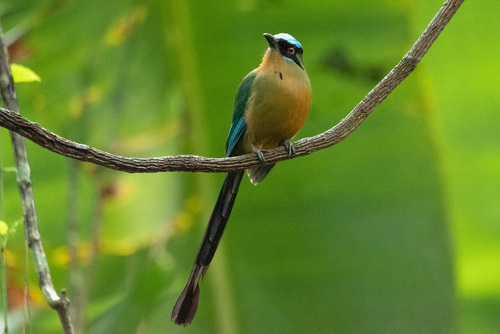
Amazonian Motmot
Momotus momota
With its stunning turquoise crown and unique 'racquet' tail, the Amazonian Motmot is one of the most iconic sights of the tropical canopy. Known for its rhythmic, pendulum-like tail-wagging, this elusive beauty is a master of the sit-and-wait hunt.
Quick Identification
Size
Length: 38–48 cm (15–19 in); Weight: 77–145 g (2.7–5.1 oz)
Colors
Olive-green upperparts, rufous-cinnamon underparts, black face mask bordered by turquoise, and a bright turquoise crown ring.
Key Features
- Racquet-tipped central tail feathers
- Bright turquoise diadem or crown ring
- Black eye mask
- Pendulum-like tail wagging
- Heavily serrated bill
When You’ll See Them
Geographic range
Where Does the Amazonian Motmot Live?
Native to the South American continent, the Amazonian Motmot is the quintessential bird of the Amazon Basin. Its primary range encompasses the vast lowland forests of Brazil, Peru, Colombia, and Venezuela, extending southward into the moist foothills of the Andes and into portions of Bolivia and Paraguay. While it remains a lowland specialist, it thrives wherever there is sufficient humidity and dense canopy cover across the heart of South America.
Basemap © OpenStreetMap contributors
Behavior
The Amazonian Motmot is a master of patience, often spending long periods perched motionless on mid-story branches while scanning for prey. Despite their bright colors, they can be surprisingly difficult to spot in the dappled light of the rainforest until they perform their signature 'pendulum' display. When the bird detects a potential predator or a rival, it wags its long tail back and forth like a clock pendulum, a behavior thought to signal to the intruder that it has been spotted.
These birds are largely solitary or found in pairs. They are non-migratory and defend permanent territories. Unlike many other tropical birds that nest in tree hollows, motmots are famous for being tunnel-nesters. They use their heavy bills to excavate long burrows into earth banks, often along riverbanks or road cuts, where they raise their young in relative safety from arboreal predators.
EverydayEarth exclusive
Camera Tips
To capture an Amazonian Motmot on camera, focus your efforts on the mid-story of the forest rather than the ground or the high canopy. These birds love 'perch-hunting' from horizontal branches that offer a clear view of the surrounding foliage. Aim your camera at branches roughly 2 to 5 meters off the ground, particularly those near fruit-bearing trees like figs or palms. Because they are sit-and-wait predators, they may remain in the frame for several minutes, so set your camera to take short video clips rather than just stills to capture their unique tail-wagging behavior.
If you have an earth bank or a steep slope on your property, keep an eye out for circular holes about 8-10cm in diameter. During the breeding season, these are likely nest tunnels. Positioning a camera a few meters away from a nest entrance (without disturbing the area) is the best way to see the adults bringing food—often large cicadas or lizards—to their chicks. Use a high-speed trigger if possible, as their flight into the tunnel is incredibly fast.
Lighting is your biggest challenge in the rainforest. Motmots prefer the shade and can disappear into the shadows. Use a camera with a high-quality sensor and a wide aperture (low f-stop). If your camera has a 'quiet' shutter mode, enable it; while they aren't easily spooked by movement, sudden mechanical sounds can cause them to fly off. Early morning just after sunrise is the 'golden hour' for motmot activity when they are most vocal and active.
Similar Species
Species that look similar or are commonly confused with Amazonian Motmot.
Rufous Motmot
Much larger with an entirely rufous-colored head and breast, lacking the turquoise crown ring.
Blue-capped Motmot
Found in Mexico and Central America; it has a more solid blue crown and lacks the cinnamon-colored nape of southern populations.
Broad-billed Motmot
Smaller with a much wider bill and lacks the distinct racquet-tips on the tail found in the Momotus genus.
Frequently Asked Questions
Record Amazonian Motmot at your habitat
Connect a camera to start building your own species record — AI identifies every visitor automatically.