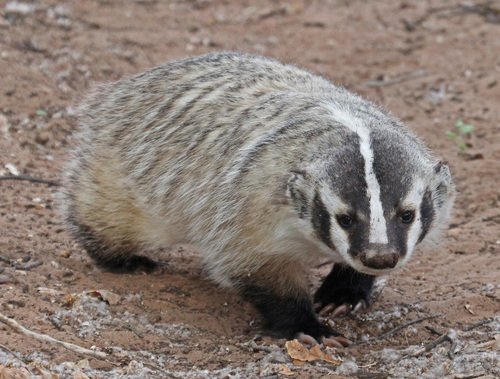
American Badger
Taxidea taxus
The undisputed heavyweight champion of the prairie, the American Badger is a stocky, powerful digger known for its striking facial 'badges' and legendary toughness. From the Great Plains to high alpine meadows, these fossorial marvels spend their lives engineering the landscape one burrow at a time.
Quick Identification
Size
Length: 60–75 cm (23.5–29.5 in); Weight: 6.3–12 kg (14–26 lbs)
Colors
Grizzled gray-to-brown body with a white dorsal stripe; black and white facial markings including black 'badges' on the cheeks.
Key Features
- Extremely flattened, stocky body
- Large, powerful front claws up to 2 inches long
- White stripe running from the nose over the top of the head
- Distinctive black patches on the cheeks
When You’ll See Them
Geographic range
Where Does the American Badger Live?
Native to the North American continent, the American Badger is most prevalent across the Great Plains and western regions of the United States. Its core range extends from the south-central provinces of Canada, such as Alberta and Saskatchewan, down through the western and central U.S. to the dry plateau regions of central Mexico. While they are most abundant in open country, they can occasionally be found in parklands and forest edges from sea level up to high mountain meadows.
Basemap © OpenStreetMap contributors
Behavior
The American Badger is a master architect of the underground, capable of digging through packed soil at astonishing speeds to pursue prey or create dens. While they are primarily solitary creatures, they are famous for a rare interspecies cooperation where they occasionally hunt alongside coyotes; the badger digs out rodents while the coyote catches those that flee above ground.
Badgers are known for their fierce temperament when cornered, but they generally prefer to avoid human contact. They are wide-ranging animals that maintain several dens within a home range, often sleeping in a different hole each night during the summer months. Though they do not truly hibernate, they may enter a state of torpor during the coldest parts of winter.
EverydayEarth exclusive
Camera Tips
To capture the elusive American Badger, camera placement is everything. These animals are low-slung, so your camera must be positioned no more than 6 to 12 inches off the ground. Aiming the camera parallel to the ground or slightly upward will help you capture their distinctive facial 'badges' and powerful claws rather than just a grizzled back. Look for large, oval-shaped burrows (often 8-12 inches wide) with fresh mounds of dirt, which indicate an active resident.
Badgers are primarily nocturnal and highly sensitive to scent and light. While they may tolerate a standard infrared (IR) flash, using a 'no-glow' or black LED camera is highly recommended to avoid spooking them, as they can be surprisingly shy around new objects. If you are targeting a specific burrow, place the camera at least 5-10 feet away to ensure the wide-angle lens captures the badger emerging or entering the hole.
While we don't recommend baiting near homes, a small amount of scent lure—such as fish oil or a commercial predator gland lure applied to a nearby log—can pique their curiosity long enough for a clear photo. Because badgers are most active during the warmer months when their prey is active, late spring through early autumn is the best time to monitor your backyard or trail camera. Set your device to take short video clips (10-15 seconds) rather than just stills, as badgers are often in motion, and video captures their unique, rolling waddle and digging behaviors far better than a single frame.
Similar Species
Species that look similar or are commonly confused with American Badger.
European Badger
Taller, less flat body with two vertical black facial stripes rather than the American badger's single dorsal stripe and cheek badges.
Wolverine
Much larger and taller with a darker, more uniform brown coat and a bushy tail; lacks the white facial stripe of the badger.
Striped Skunk
Smaller and more slender with two white stripes forming a 'V' on the back, whereas the badger has a single thin stripe on the head and a grizzled gray body.
Frequently Asked Questions
Record American Badger at your habitat
Connect a camera to start building your own species record — AI identifies every visitor automatically.