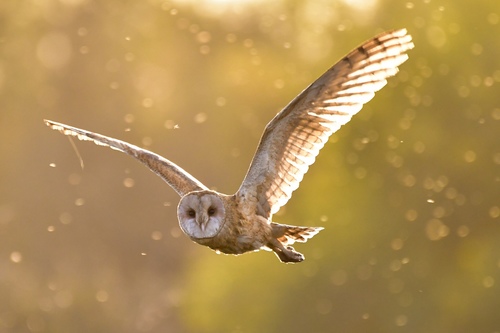
American Barn Owl
Tyto furcata
Known as the 'Ghost Owl' for its silent flight and stark white face, the American Barn Owl is nature's most elegant nocturnal hunter. A master of acoustic precision, it can pinpoint a heartbeat in total darkness.
Quick Identification
Size
Length: 32–40 cm (12.6–15.8 in); Wingspan: 107–110 cm (42–43.3 in); Weight: 400–700 g (14.1–24.7 oz)
Colors
Pale, heart-shaped white facial disk; honey-gold and light gray upperparts with fine black-and-white speckles; pure white to creamy-buff underparts. Females are often more heavily spotted and darker than males.
Key Features
- Distinctive white heart-shaped facial disk with dark eyes
- Ghostly white underparts visible in flight
- Long, feathered legs and lacks ear tufts
- Characteristic raspy, hissing shriek instead of a typical 'hoot'
When You’ll See Them
Sightings on EverydayEarth
May 28, 2026
An American Barn Owl is perched on a conifer branch during the night. It is alert and scans the environment by rotating its head nearly 180 degrees. A small moth or nocturnal insect briefly flutters into view in the lower right foreground near the end of the clip.
May 28, 2026
An American Barn Owl is perched on a thick branch within a coniferous tree. It remains mostly still, occasionally shifting its weight and turning its head to scan the surrounding area under the cover of night.
May 23, 2026
An American Barn Owl is perched on a pine branch during the night. It is seen primarily from the back, showing its mottled plumage, until it turns its head to scan the area, revealing its pale facial features and large, dark eyes in the infrared light.
May 23, 2026
A Barn Owl is perched on a tree branch during the night. It remains mostly stationary, occasionally shifting its weight and turning its head to scan the surroundings, which clearly reveals its pale facial features.
Geographic range
Where Does the American Barn Owl Live?
The American Barn Owl is native to the Americas, spanning a massive latitudinal range from southern Canada across nearly the entire United States and southward through Central America into the tip of South America. While they are found throughout most of the contiguous U.S., they are most abundant in the milder climates of the south and west. Beyond their native continental range, they have been successfully introduced to the Hawaiian Islands to help manage rodent populations in sugar cane fields.
Basemap © OpenStreetMap contributors
Behavior
The American Barn Owl is a strictly nocturnal hunter, renowned for its ghostly appearance and incredibly silent flight. Unlike many other owls that defend territories with rhythmic hoots, the Barn Owl communicates through a series of eerie, raspy shrieks and hisses. They are highly specialized hunters that rely more on their acute hearing than their sight; their asymmetrical ear placement allows them to triangulate the exact position of a mouse moving under deep grass or even snow.
Socially, they are often monogamous and frequently return to the same nesting sites year after year. While they are naturally cave and hollow-tree nesters, they have adapted remarkably well to human environments, favoring man-made structures like barns, silos, and church steeples. This proximity to humans is largely beneficial, as they act as highly efficient, natural pest controllers for agricultural areas.
EverydayEarth exclusive
Camera Tips
To capture high-quality footage of an American Barn Owl, placement is everything. If you have a barn or outbuilding, look for 'whitewash' (white droppings) or owl pellets on the floor, which indicate a preferred roosting spot. Mount your camera high up on a beam or rafter, ideally 10-15 feet off the ground, angled slightly downward toward a known perch. In suburban backyards, placing a camera on a 10-foot pole facing a specialized Barn Owl nest box is the most effective strategy.
Because these owls are strictly nocturnal, your camera's Infrared (IR) capabilities are critical. Ensure your camera has 'No-Glow' or 'Low-Glow' IR LEDs to avoid spooking the bird, as they have incredibly sensitive vision. Set your camera to 'Video Mode' with a 15-20 second trigger; Barn Owls are often very still while perched, but their take-offs and landings are spectacular to witness. A fast trigger speed (under 0.3 seconds) is essential to catch them as they swoop into the frame.
Avoid using any form of artificial light or flash, as this can disrupt their hunting and potentially expose them to predators like Great Horned Owls. During the breeding season, keep your distance and manage the camera remotely if possible to avoid disturbing the nest. If you are using a trail camera in an open field, look for 'fence post' perches—Barn Owls often stop here to listen for prey before diving into the grass.
Similar Species
Species that look similar or are commonly confused with American Barn Owl.
Great Horned Owl
Much larger with prominent ear tufts, yellow eyes, and a classic hooting call.
Barred Owl
Rounder head without a heart-shaped disk, dark brown eyes, and a 'Who cooks for you' call.
Short-eared Owl
More likely to be seen at dawn/dusk, has yellow eyes, and nests on the ground in open fields.
Frequently Asked Questions
Record American Barn Owl at your habitat
Connect a camera to start building your own species record — AI identifies every visitor automatically.