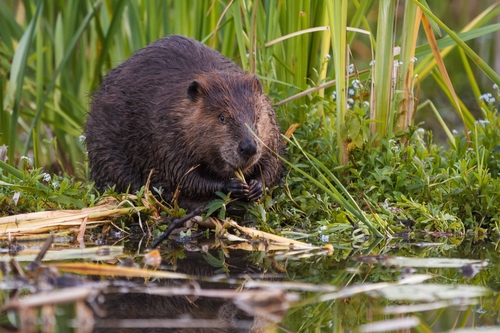
American Beaver
Castor canadensis
The ultimate landscape architect, the American Beaver is a keystone species that creates entire ecosystems through its dam-building prowess. From its paddle-shaped tail to its waterproof fur, every inch of this rodent is perfectly adapted for a life of engineering.
Quick Identification
Size
Body length 2.4-3.3 ft (74-100 cm); tail 8-12 in (20-30 cm); weight 24-71 lbs (11-32 kg)
Colors
Rich dark brown to reddish-brown waterproof fur; blackish-gray scaly tail; dark webbed hind feet
Key Features
- Broad, horizontally flattened scaly tail
- Large orange-enameled front incisors
- Webbed hind feet and small dexterous front paws
- Valves in nose and ears that close underwater
When You’ll See Them
Geographic range
Where Does the American Beaver Live?
Native to the North American continent, the American Beaver is found throughout the majority of Canada and the United States, reaching as far north as the Alaskan treeline and as far south as northern Mexico. They are remarkably resilient, inhabiting environments ranging from high mountain streams to suburban drainage basins. Beyond their native range, they have established significant introduced populations in the Patagonia region of South America and parts of Scandinavia and Russia, where they were originally brought for the fur trade.
Basemap © OpenStreetMap contributors
Behavior
American Beavers are nature's premier ecosystem engineers, famous for their ability to transform dry land into thriving wetlands by constructing dams. These industrious rodents live in tight-knit family units called colonies, usually consisting of a monogamous pair and two generations of offspring. They are highly territorial and use 'scent mounds' made of mud and castoreum to mark their boundaries. While they are primarily nocturnal or crepuscular, they can occasionally be seen during the day in undisturbed areas.
Communication is vital to beaver social life. The most iconic behavior is the tail slap; when threatened, a beaver will strike the water's surface with its broad tail, creating a loud crack that warns the family to dive for safety. In their interactions with humans, beavers are generally shy and non-aggressive, though their engineering projects can sometimes lead to conflicts when they flood roads or ornamental landscapes. They spend much of the autumn in a flurry of activity, repairing dams and stockpiling a 'midden' or food cache of submerged branches to survive the winter.
EverydayEarth exclusive
Camera Tips
To capture high-quality footage of an American Beaver, location is everything. Look for 'beaver slides'—well-worn, muddy paths where they drag logs from the woods into the water. Mount your camera about 12-18 inches off the ground, angled slightly toward the water's edge or across the path. If you can find a scent mound (a pile of mud and debris near the bank), this is a prime spot for a camera, as beavers will frequently stop to investigate and refresh the scent.
Because beavers are most active between dusk and dawn, ensure your camera has a strong infrared (IR) flash with a fast trigger speed. Use the 'Video' or 'Hybrid' mode rather than still photos; beavers move with a slow, steady gait, and a 20-second video clip captures their fascinating behavior far better than a single frame. Set your camera to a high sensitivity (PIR) setting, as their wet fur can sometimes blend in with the ambient temperature of the mud and water.
Late summer and autumn are the best times for trail camera trapping. During these months, beavers are frantically repairing their dams and building underwater food caches for the winter. You will often capture them carrying large branches or patting mud into place with their front paws. If you are setting up near a dam, be mindful of water levels; a heavy rain can cause the pond to rise rapidly, potentially submerging your camera. Always use a secure tree mount and consider a security box if you are in a semi-public area, though the beavers themselves are unlikely to mess with your gear.
Similar Species
Species that look similar or are commonly confused with American Beaver.
Frequently Asked Questions
Record American Beaver at your habitat
Connect a camera to start building your own species record — AI identifies every visitor automatically.