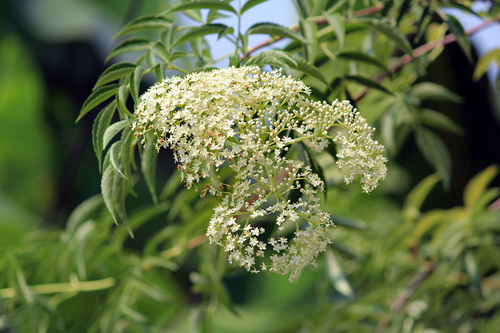
American black elderberry
Sambucus canadensis
A powerhouse of the backyard ecosystem, the American black elderberry offers a stunning display of white summer blooms followed by a bounty of dark, wildlife-friendly berries.
Quick Identification
Size
A multi-stemmed shrub reaching 3-4 meters (10-13 feet) in height and width
Colors
Bright green leaves, creamy white flower clusters, and deep purple-to-black ripe fruit
Key Features
- Large, flat-topped clusters of tiny white flowers
- Opposite, pinnate compound leaves with 5-11 leaflets
- Drooping bunches of small, dark purple-black berries
- Soft, pithy stems with grayish-brown bark and bumps
When You’ll See Them
Geographic range
Where Does the American black elderberry Live?
Native to North America, the American black elderberry is a staple of eastern and central ecosystems. Its primary range extends from the edge of the Great Plains eastward to the Atlantic coast, spanning from Manitoba and Nova Scotia down through the United States to Florida and Texas. It is also commonly found throughout Mexico and parts of Central America, thriving in almost any landscape with sufficient moisture and sunlight.
Basemap © OpenStreetMap contributors
Behavior
The American black elderberry is a fast-growing, deciduous shrub that functions as a central hub for backyard biodiversity. In late spring and early summer, it produces massive, fragrant flower displays that act as a primary nectar source for honeybees, butterflies, and hoverflies. Because it spreads via suckers, it often forms dense thickets that provide excellent nesting cover for songbirds like Gray Catbirds and Indigo Buntings.
As summer turns to fall, the plant undergoes a dramatic transformation as its flowers turn into heavy clusters of nutrient-dense berries. This is a critical period for local wildlife; over 40 species of birds are known to feast on the ripening fruit to fuel their migrations. While the plant is quite hardy, it thrives best in areas with consistent moisture, often signaling the presence of a high water table or nearby stream.
EverydayEarth exclusive
Camera Tips
To capture the best footage of wildlife visiting your American black elderberry, position your camera about 4 to 5 feet off the ground, angled slightly downward toward a large cluster of berries or flowers. Because this plant attracts a high volume of birds, use a camera with a fast trigger speed (0.3 seconds or less) to catch songbirds as they land. If your camera has a 'hybrid' mode, set it to take a high-resolution photo followed by a 10-second video to document both the species and their feeding behavior.
The white flower clusters can be highly reflective in direct midday sun, which often leads to 'blown out' or overexposed images. For the best visual results, position the camera so the sun is behind it or wait for slightly overcast days when the light is diffused. If you are targeting pollinators like the giant swallowtail butterfly, use the 'Time Lapse' setting during the morning hours (8 AM to 11 AM) when nectar production is at its peak and insect activity is highest.
In the late summer, focus your lens on the ripening dark berries. This is the best time to see mammals like raccoons or opossums visiting the lower branches at night. For these nocturnal visitors, ensure your PIR (motion) sensor sensitivity is set to 'High' since the movement of a bird or small mammal among the leaves can be subtle. If your camera has a focal adjustment, set it for a close-range 'macro' feel to capture the intricate details of the fruit and the visitors' beaks.
Similar Species
Species that look similar or are commonly confused with American black elderberry.
Frequently Asked Questions
Record American black elderberry at your habitat
Connect a camera to start building your own species record — AI identifies every visitor automatically.