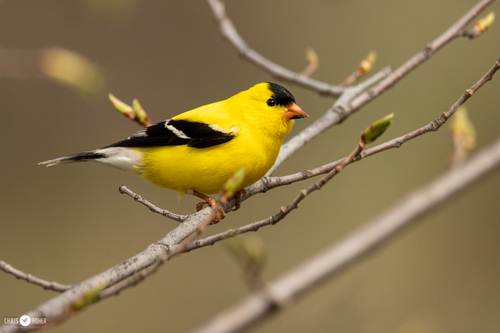
American Goldfinch
Spinus tristis
Often called the 'wild canary,' the American Goldfinch is a vibrant burst of yellow that brings acrobatic energy and musical cheer to backyards across North America.
Quick Identification
Size
Length: 11-14 cm (4.3-5.5 in); Wingspan: 19-22 cm (7.5-8.7 in); Weight: 11-20 g (0.39-0.71 oz)
Colors
Breeding males are bright lemon-yellow with a black cap and black wings with white bars. Females and non-breeding males are a duller olive-brown or tan.
Key Features
- Vibrant yellow body with a distinct black forehead cap on males
- Short, conical pinkish bill optimized for seeds
- Deeply notched tail and black wings with two prominent white bars
- Rhythmic, undulating flight pattern
When You’ll See Them
Sightings on EverydayEarth
Jul 7, 2026
A vibrant male American Goldfinch lands on the edge of the white feeder tray. It hops along the rim, peering into the tray to forage for seeds before flying off.
Apr 2, 2026
A male Northern Cardinal and an American Goldfinch share the feeder tray. The cardinal perches on the left, occasionally turning its head to look at the camera, while the smaller goldfinch stays on the right side, busy selecting and husking seeds.
Apr 8, 2026
A male American Goldfinch in its bright spring plumage visits the feeder, perching on the rim to forage for seeds while keeping a watchful eye on its surroundings.
Jul 24, 2026
A vibrant male American Goldfinch perches on a tube feeder, busily extracting seeds. Below, a juvenile bird, likely a Brown-headed Cowbird, sits on the main feeder tray, looking around and occasionally chirping. The surrounding woods are lush and green under the afternoon sun.
Jul 22, 2026
In the late afternoon sun, a pair of male Downy Woodpeckers visit the feeding station, with one clinging to the suet feeder on the left and another on the central wooden support. An American Goldfinch with olive-yellow feathers is also present, perched on the seed tube to the right.
Jul 21, 2026
The feeder station is very active with several species visiting. A female Red-winged Blackbird feeds on the suet block while a yellow American Goldfinch briefly visits the tube feeder. Soon, several male Red-winged Blackbirds arrive, showing off their red shoulder patches. A speckled European Starling also lands on the tray to forage for fallen seeds.
Geographic range
Where Does the American Goldfinch Live?
The American Goldfinch is native to the North American continent, occupying a vast territory that shifts with the seasons. Its core breeding range extends from southern Canada, including regions like British Columbia and Quebec, down through the central and northern United States. As a partial migrant, many populations move south during the winter, reaching as far as the Gulf Coast and the highlands of Mexico. Because they are so well-adapted to human landscapes, they are a common year-round sight in most of the contiguous United States, thriving in suburban parks and agricultural edges.
Basemap © OpenStreetMap contributors
Recorded on EverydayEarth
Behavior
The American Goldfinch is a highly social and energetic songbird, often found in small, chatty flocks outside of the nesting season. They are remarkably acrobatic foragers, frequently seen clinging to the tops of thistle or sunflower heads, often hanging completely upside down to reach seeds that other birds cannot access. Their flight is one of their most identifying traits; they travel in a wavy, 'roller coaster' motion, frequently emitting a cheerful 'per-chic-o-ree' call at the peak of each undulation.
Unlike many other songbirds, goldfinches are strict vegetarians, feeding their young a diet of regurgitated seeds rather than insects. This unique dietary requirement leads them to be among the latest nesters in North America, waiting until July or August when thistle and milkweed have gone to seed to provide both food and nesting material. Around humans, they are bold and easily attracted to backyard feeding stations, especially those offering specialized small seeds.
EverydayEarth exclusive
Camera Tips
To capture the best footage of American Goldfinches, focus your camera efforts on their specific feeding preferences. Because they prefer tiny seeds, use a Nyjer (thistle) 'sock' or a tube feeder with specialized narrow ports. Place your camera on a tripod or mount it approximately 3 to 4 feet away from the feeder. To get those iconic 'action' shots of them hanging upside down, ensure the camera is angled to see the bottom and sides of the feeder, rather than just the perches.
Lighting is the most important factor for these birds; their bright yellow feathers can easily become 'blown out' or overexposed in harsh midday sun. Aim your camera so the sun is behind you, illuminating the bird directly during the golden hours of early morning or late afternoon. This will make the yellow plumage pop against the background. If your camera has a high-speed trigger or burst mode, enable it, as goldfinches are twitchy and fast-moving flyers.
Don't overlook the power of water. Goldfinches are frequent visitors to birdbaths, especially those with moving water or a shallow dripper. Placing a camera near a solar-powered fountain can result in fantastic footage of social bathing behavior. During late summer, try moving your camera to natural food sources like stands of Purple Coneflower or Cup Plant. These native plants provide a much more aesthetic and natural backdrop for your AI-powered camera captures than plastic feeders.
Similar Species
Species that look similar or are commonly confused with American Goldfinch.
Frequently Asked Questions
Record American Goldfinch at your habitat
Connect a camera to start building your own species record — AI identifies every visitor automatically.