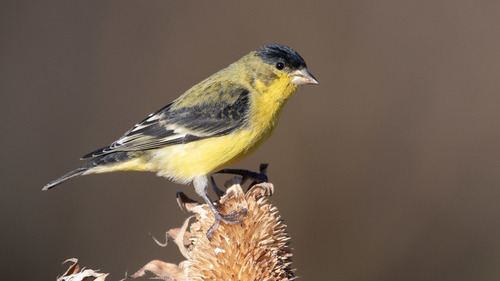
Lesser Goldfinch
Spinus psaltria
The smallest goldfinch in North America, the Lesser Goldfinch is a bundle of yellow energy that lights up backyards from Oregon to Peru. Known for their incredible mimicry and social nature, these acrobatic seed-eaters are a delight for any backyard observer.
Quick Identification
Size
9-12 cm (3.5-4.7 inches) long; wingspan of 19-22 cm (7.5-8.7 inches); weight of 8-11.5 g (0.3-0.4 oz)
Colors
Males feature bright yellow underparts, a distinct black cap, and a back that ranges from forest green to solid black. Females are more muted olive-green with pale yellow bellies.
Key Features
- Distinctive black cap on males
- Bright yellow underparts with white wing patches
- Small, stubby conical bill
- Acrobatic feeding posture, often hanging upside down
When You’ll See Them
Sightings on EverydayEarth
Jun 14, 2026
A male House Finch with vibrant red plumage perches on top of the suet cage, while a male Lesser Goldfinch with bright yellow feathers feeds on the side. Other finches move through the dense green foliage in the background.
Jun 8, 2026
A White-winged Dove is perched on the central wooden post before taking flight, showing its prominent white wing patches. A male House Finch is visible on the upper-left crossbeam, while several Lesser Goldfinches actively feed at the tube feeder on the left side of the frame.
Jun 7, 2026
A Mexican Jay lands on the edge of a rocky water basin to drink, while a White-winged Dove forages on the ground in the foreground. A Lesser Goldfinch is also seen visiting the far side of the water source.
Jun 6, 2026
A male House Finch with bright rosy plumage and a streaked female companion are seen feeding together at the tube feeder. Meanwhile, a Lesser Goldfinch perches on the mesh tray feeder to the right, occasionally looking around between bites of seed.
Jun 6, 2026
Several House Finches and a bright yellow Lesser Goldfinch are busy feeding at the tube feeder. In the final seconds, a blue-gray Mexican Jay glides into the frame and perches momentarily on the suet block before departing.
May 29, 2026
A diverse group of birds visits the sanctuary's feeding area in the late afternoon sun. A White-winged Dove is prominently visible on the lower wooden platform, pecking at scattered seeds. On the left, a Mexican Jay initially occupies the tube feeder before being replaced by a small Lesser Goldfinch. High on the wooden frame, an Acorn Woodpecker perches and surveys the surroundings.
Geographic range
Where Does the Lesser Goldfinch Live?
The Lesser Goldfinch is a native of the Americas, boasting a massive range that begins in the western United States and extends through Mexico and Central America into the Andean foothills of South America. Within the U.S., they are a staple species from Washington and California across to Texas. Their territory continues through the highlands of Central America into Colombia, Venezuela, and as far south as Peru.
Basemap © OpenStreetMap contributors
Behavior
Lesser Goldfinches are gregarious and highly social birds that are almost always seen in pairs or small, talkative flocks. They are famous for their acrobatic foraging style, often clinging to the very tips of swaying seed heads or hanging upside down to reach difficult seeds. Unlike some more timid finches, they adapt remarkably well to human environments and are frequent visitors to backyard bird feeders, where they will playfully squabble with one another for the best perching spot.
One of their most charming traits is the male's ability to mimic other birds. Their song is a long, rambling series of wheezes, trills, and chips that often incorporates the calls of hawks, scrub-jays, or even killdeer. In hotter climates, they are particularly reliant on water and will visit birdbaths multiple times a day in large groups to drink and bathe together.
EverydayEarth exclusive
Camera Tips
To capture the best footage of Lesser Goldfinches, focus your AI camera on specialized 'thistle' or nyjer seed feeders. Because these birds are quite small and move rapidly, place your camera roughly 3 to 5 feet away from the feeder at eye level. Using a camera with a high-speed trigger or a pre-buffer recording feature is essential to catch them as they land, as they often flutter in and out quickly rather than perching for long periods.
Water is an incredibly effective lure for this species, especially in arid western regions. A shallow birdbath with a moving water feature, like a solar-powered dripper or fountain, is nearly irresistible to them. Position your camera to face the water source with the sun at your back to highlight the vibrant yellow plumage of the males. They are most active at water sources during the 'golden hours' of early morning and late afternoon.
If you want to capture more natural behavior, mount your camera near wild patches of sunflowers, zinnias, or thistles. Lesser Goldfinches love to cling to these seed heads and tear them apart. Setting your camera to 'Burst Mode' or a high-frame-rate video setting (60fps or higher) will allow you to see the incredible detail of their wings and their expressive facial movements as they work on a seed. Because they are social, a wider field of view is often better than a tight zoom so you can capture the interactions of the entire flock.
Similar Species
Species that look similar or are commonly confused with Lesser Goldfinch.
Frequently Asked Questions
Record Lesser Goldfinch at your habitat
Connect a camera to start building your own species record — AI identifies every visitor automatically.