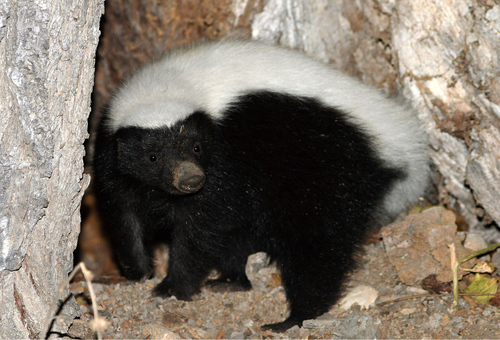
American Hog-nosed Skunk
Conepatus leuconotus
The American Hog-nosed Skunk is the powerhouse of the skunk family, known for its distinctive plow-like snout and striking single white stripe. A master digger, this elusive nocturnal mammal is a fascinating visitor for anyone with a trail camera in the American Southwest or Mexico.
Quick Identification
Size
Total length 44–82 cm (17–32 in); weight 1.1–4.5 kg (2.4–9.9 lbs)
Colors
Deep black body with a single, very broad white stripe extending from the crown of the head to the base of the tail; the tail is almost entirely white.
Key Features
- Long, hairless, flexible snout resembling a pig's nose
- Single broad white stripe covering the entire back
- Extremely long, thick front claws for digging
- Entirely white bushy tail
When You’ll See Them
Geographic range
Where Does the American Hog-nosed Skunk Live?
Native to the Americas, the American Hog-nosed Skunk occupies a broad range from the southern United States through Mexico and into parts of Central America. In the U.S., they are most commonly found in the Edwards Plateau of Texas and across the scrublands of New Mexico and Arizona. They are well-adapted to varied terrains, from sea-level coastal plains to high-altitude mountain forests, provided the soil is suitable for their intensive digging habits.
Basemap © OpenStreetMap contributors
Behavior
The American Hog-nosed Skunk is a specialized forager known for its unique "plowing" behavior. Unlike other skunk species that might scavenge on the surface, this skunk uses its powerful, rubbery snout and long front claws to overturn soil and rocks in search of subterranean larvae. They are primarily nocturnal and lead solitary lives, spending their daylight hours tucked away in rock crevices, hollow logs, or burrows they have excavated themselves.
While they possess the famous defensive scent glands characteristic of all skunks, the American Hog-nosed Skunk is generally considered less prone to spraying than its striped cousins. They often rely on their formidable digging strength and stocky build to navigate their environment. When threatened, they may perform a "handstand" or stomp their feet as a warning before deploying their musk. In suburban areas, they are shy and rarely interact directly with humans, though their presence is often given away by the distinctive cone-shaped holes they leave in lawns or garden beds.
EverydayEarth exclusive
Camera Tips
To capture the American Hog-nosed Skunk, place your camera low to the ground—no more than 12 inches high—and angle it slightly downward. These animals spend the vast majority of their time with their noses to the earth, so a low perspective is essential to catch their unique facial features and digging behavior. Look for "rooting" signs: areas of disturbed soil that look like a small plow has run through them, which are much more chaotic than the neat holes left by squirrels.
Since they are driven by a high-protein diet, lures such as sardines in oil or commercial predator baits with a heavy shellfish scent work exceptionally well. If you prefer a natural approach, lightly watering a patch of lawn in a dry climate can draw grubs to the surface, which in turn attracts the skunk to that specific spot for a midnight snack. This "natural baiting" often results in the best footage of their unique foraging mechanics.
Set your camera to capture short video clips (15-20 seconds) rather than just still photos. The way the Hog-nosed Skunk uses its snout to maneuver rocks and debris is its most fascinating trait, and video is the only way to truly appreciate this "bulldozing" motion. Ensure your camera's infrared flash is set to a medium intensity; their broad white back can easily overexpose or "white out" in night shots if the flash is too close or too bright.
Similar Species
Species that look similar or are commonly confused with American Hog-nosed Skunk.
Striped Skunk
Smaller with two distinct white stripes on the back and a black-and-white tail, unlike the single wide stripe and solid white tail of the hog-nosed.
Hooded Skunk
Features a much longer, finer-haired tail and a 'hood' of fur around the neck; lacks the large, rubbery snout of the hog-nosed.
Frequently Asked Questions
Record American Hog-nosed Skunk at your habitat
Connect a camera to start building your own species record — AI identifies every visitor automatically.