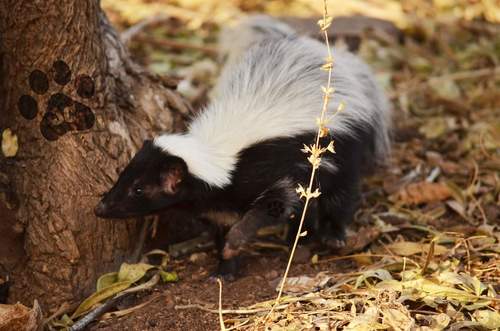
Hooded Skunk
Mephitis macroura
Boasting a flowing white mane and an elegantly long tail, the Hooded Skunk is the desert's most stylish nocturnal wanderer. Often mistaken for its striped cousin, this elusive mammal is a master of the Southwestern night.
Quick Identification
Size
Total length of 55–80 cm (22–31 in); weight typically ranges from 0.4–2.7 kg (0.9–6 lbs).
Colors
Deep black base with white markings; typically displays either a solid white back or two thin white side-stripes; features a distinctive 'hood' of long white hair on the nape.
Key Features
- Distinctive ruff or 'hood' of long fur on the neck and head
- Exceptionally long, bushy tail that is often longer than the body
- Smaller, more slender frame than the common Striped Skunk
- Small, rounded ears nearly hidden by the neck fur
When You’ll See Them
Geographic range
Where Does the Hooded Skunk Live?
Native to the southern North American continent and Central America, the Hooded Skunk is a specialist of the arid Southwest. Its core range begins in the southern regions of Arizona, New Mexico, and Texas, extending across nearly the entirety of Mexico. Further south, populations thrive through the highlands of Guatemala, Honduras, Nicaragua, and into Costa Rica, where they favor brushy areas near water sources. This species is rarely found in the colder, northern reaches of the United States, preferring the subtropical and semi-arid climates of the lower latitudes.
Basemap © OpenStreetMap contributors
Behavior
The Hooded Skunk is a shy, nocturnal mammal that is often overshadowed by its more famous relative, the Striped Skunk. Unlike many other skunk species, the Hooded Skunk is exceptionally agile and is known to be more elusive, preferring to stick to the cover of dense vegetation or rocky outcrops. While they are solitary by nature, they are not strictly territorial and may overlap ranges where food is abundant.
When threatened, the Hooded Skunk employs the classic mephitid defense: a potent, foul-smelling spray from its anal glands. However, it often attempts to flee first, using its long tail as a distractor. In suburban environments, they are less bold than Striped Skunks but will occasionally frequent backyards that offer consistent water sources or fallen fruit, usually moving through silently under the cover of total darkness.
EverydayEarth exclusive
Camera Tips
To capture high-quality footage of a Hooded Skunk, camera placement is everything. Since these skunks are highly dependent on water in their arid environments, aim your camera at ground level (about 6-10 inches high) near birdbaths, dripping faucets, or small garden ponds. They tend to follow 'edges,' so placing your camera along a fence line or a dense hedge row will increase your chances of a sighting as they navigate your yard.
Because they are strictly nocturnal, ensure your camera has a high-quality infrared (no-glow) flash to avoid startling them. They have very sensitive eyes, and a bright white flash may cause them to avoid the area in the future. Set your camera to take short video clips (10-15 seconds) rather than just stills; this allows you to see the fluid movement of their exceptionally long tails and the unique 'hooded' fur on their necks, which can be hard to distinguish in a single grainy photo.
If you want to lure them into view, strong-smelling baits work best. A small amount of canned cat food (fish-based) or even peanut butter smeared on a rock can keep them stationary long enough for a clear shot. During the late summer and fall, fallen fruit like figs or berries can also be a natural attractant. Just be mindful that these baits may also attract larger predators or more aggressive scavengers like raccoons.
Similar Species
Species that look similar or are commonly confused with Hooded Skunk.
Striped Skunk
The Striped Skunk has shorter fur on the neck and a distinctive white 'V' pattern on its back, whereas the Hooded Skunk has a long ruff of neck fur and a much longer tail.
American Hog-nosed Skunk
Hog-nosed skunks have a completely white tail and a broad, hairless snout used for rooting, lacking the long neck ruff of the Hooded Skunk.
Frequently Asked Questions
Record Hooded Skunk at your habitat
Connect a camera to start building your own species record — AI identifies every visitor automatically.