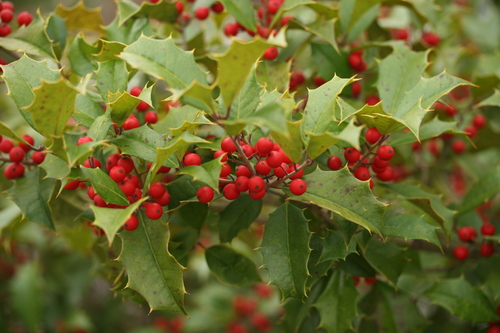
American holly
Ilex opaca
A classic icon of the American winter, the American holly provides vital sanctuary and a winter feast for backyard birds. With its glossy, spiny leaves and brilliant red fruit, this native evergreen is a year-round hub of wildlife activity.
Quick Identification
Size
Height: 10–20 m (30–60 ft); Spread: 5–12 m (15–40 ft); Trunk diameter: 30–60 cm (1–2 ft)
Colors
Deep olive to dark green glossy foliage; bright scarlet or red berries on female trees; smooth, light gray bark
Key Features
- Spiny-margined, thick evergreen leaves
- Vibrant red berries that persist through winter
- Smooth, light gray bark often dotted with lichens
- Pyramidal or conical growth habit
When You’ll See Them
Geographic range
Where Does the American holly Live?
Native to the North American continent, the American holly is a staple of the eastern and south-central United States. Its natural range extends from the coastal forests of Massachusetts down the Atlantic seaboard to central Florida, reaching westward into the Gulf States, eastern Texas, and north into southeastern Missouri. Because of its hardy nature and ornamental appeal, it is now widely cultivated in gardens across much of the temperate United States and parts of Europe.
Basemap © OpenStreetMap contributors
Behavior
The American holly is a slow-growing, long-lived evergreen that serves as a vital cornerstone for backyard ecosystems. As a dioecious species, individual trees are either male or female; only the females produce the iconic red berries, and they require a nearby male for pollination. Unlike many trees that go dormant and bare in the winter, the holly maintains its dense, prickly foliage year-round, providing a high-security fortress for nesting birds and small mammals seeking shelter from predators and freezing winds.
In the wild and in suburban gardens, this tree acts as a delayed-release pantry. The berries are actually quite bitter in the early autumn, but as they undergo repeated freezing and thawing cycles throughout the winter, they soften and become more palatable. This timing is perfect for migratory birds and residents like the Cedar Waxwing, which may descend upon a single tree in large, hungry flocks during the late winter months. For humans, the American holly has long been a symbol of resilience and festive cheer, though its wood is also prized for high-end inlay work due to its exceptionally pale, ivory-like color.
EverydayEarth exclusive
Camera Tips
To capture the most compelling wildlife action around an American holly, focus your camera on the fruit-laden branches of a female tree during the late winter (January through March). This is the peak window when the berries have softened enough to attract large numbers of birds. Mount your camera at a height of 5 to 8 feet, ideally on a nearby structure or a sturdy limb that gives you a clear, side-profile view of a berry cluster. A slight downward angle often helps the camera's sensor distinguish the red berries from the dark green leaves, ensuring more consistent triggers.
Because birds like American Robins, Northern Cardinals, and Cedar Waxwings move incredibly fast when feeding, set your camera to its highest sensitivity and fastest trigger speed. If your device offers a 'Burst Mode' or a high-frame-rate video setting, use it. A 10-second video clip is often better than a single still photo, as it captures the 'pluck and swallow' behavior that makes bird watching so fascinating. Be mindful of the sun's position; the waxy, glossy surface of holly leaves can reflect intense light, causing significant glare that may wash out your images during midday.
While the berries themselves are a natural bait, you can significantly increase the traffic to your camera by placing a heated birdbath within a few feet of the tree. In freezing temperatures, the combination of high-energy fruit and liquid water is irresistible. Don't forget to occasionally aim a camera at the base of the tree as well; nocturnal scavengers like opossums and raccoons frequently forage for fallen berries in the leaf litter at night, providing a different perspective on how this tree supports your local wildlife.
Similar Species
Species that look similar or are commonly confused with American holly.
Frequently Asked Questions
Record American holly at your habitat
Connect a camera to start building your own species record — AI identifies every visitor automatically.