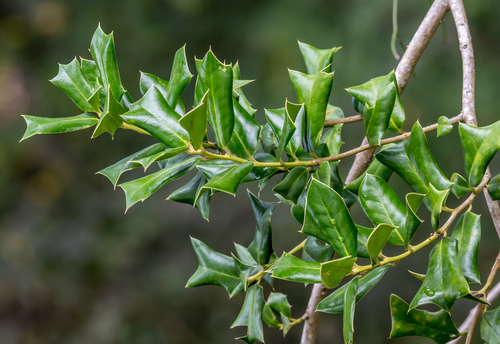
Chinese holly
Ilex cornuta
The Chinese holly is a striking evergreen known for its unique 'horned' leaves and clusters of brilliant red berries. A powerhouse of winter survival, this shrub provides critical food and dense cover for backyard birds throughout the coldest months.
Quick Identification
Size
Height: 2.5-4.5m (8-15ft); Spread: 2.5-4.5m (8-15ft)
Colors
Lustrous dark green foliage, bright scarlet-red berries, and small dull white or yellowish flowers.
Key Features
- Distinctive rectangular leaves with 3-5 sharp spines
- Dense, rounded or mounding evergreen growth habit
- Large, pea-sized red berries that persist through winter
- Glossy, thick leathery leaf texture
When You’ll See Them
Geographic range
Where Does the Chinese holly Live?
This hardy evergreen is native to East Asia, with its primary range spanning across eastern China and the Korean Peninsula. In its native lands, it is typically found growing on slopes and in valleys. Due to its popularity as an ornamental shrub, it has been widely introduced to the United States, particularly across the Southeast, where it has naturalized in many woodland and suburban environments.
Basemap © OpenStreetMap contributors
Behavior
The Chinese holly is a resilient evergreen known for its dense, mounding growth habit. While it grows slowly, it eventually forms a thick, impenetrable thicket, making it a favorite for privacy screening and security in landscaping. Its thick, leathery leaves are uniquely shaped with sharp spines that deter many herbivores, providing a safe haven for smaller creatures like songbirds and insects.
In the spring, it produces clusters of small, fragrant, off-white flowers that are highly attractive to pollinators like bees and butterflies. While many holly species require both a male and female plant to produce fruit, many cultivars of Chinese holly are parthenocarpic, meaning they can produce their iconic red berries even without a nearby male pollinator. The berries ripen in late fall and persist through the winter, providing a vital food source for birds during the leanest months of the year.
EverydayEarth exclusive
Camera Tips
Using a backyard camera to monitor a Chinese holly is an excellent way to see winter bird life. Because the plant itself doesn't move, you should treat it as a 'stage' for visiting wildlife. Position your camera about 3 to 5 feet off the ground, aiming directly at a cluster of berries. For the best composition, try to find a branch that extends slightly away from the main body of the shrub, as birds often land on these exterior 'perches' before diving into the center of the bush to feed.
The most activity will occur during the winter months when the red berries are ripe. To capture the fast-moving birds like Cedar Waxwings, Robins, and Mockingbirds that flock to the holly, set your camera to 'Burst Mode' or increase the trigger sensitivity. If your camera has a 'Video' setting, 10-second clips are often better than photos for capturing the social interactions of birds competing for the best berry clusters. Early morning light (between 7 AM and 9 AM) provides the best natural illumination for the glossy leaves.
Be aware that the waxy, highly reflective surface of the leaves can cause issues with infrared (IR) night vision. If your camera is placed too close, the IR flash may bounce off the leaves and 'white out' the image. To avoid this, place the camera at least 5 feet back from the foliage. This distance also allows for a wider field of view to catch larger mammals like deer or raccoons that might stop by to investigate the shrub or seek shelter beneath its dense canopy during the night.
Similar Species
Species that look similar or are commonly confused with Chinese holly.
Frequently Asked Questions
Record Chinese holly at your habitat
Connect a camera to start building your own species record — AI identifies every visitor automatically.