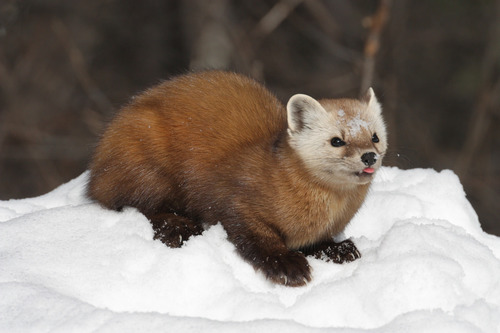
American Marten
Martes americana
Meet the forest's most acrobatic hunter. With its bright orange bib and boundless energy, the American Marten is a rare and rewarding sight for any backyard explorer.
Quick Identification
Size
Length: 48–68 cm (19–27 in); Weight: 0.5–1.4 kg (1.1–3.1 lbs)
Colors
Rich yellowish-brown to dark chocolate body; paler head; characteristic orange to cream-colored throat bib; dark legs and tail.
Key Features
- Distinctive orange or cream-colored throat 'bib'
- Long, slender body with a bushy tail roughly half its body length
- Prominent triangular ears with pale edging
- Large paws with semi-retractable claws for climbing
When You’ll See Them
Geographic range
Where Does the American Marten Live?
Native to the northern reaches of North America, the American Marten thrives across the vast boreal forests of Canada and Alaska. Their range extends southward into the contiguous United States, specifically throughout the Rocky Mountains, the Sierra Nevada, and the dense forests of the Northeast and Great Lakes regions. While they are widespread in high-latitude wilderness, their presence in the lower 48 states is often restricted to high-elevation montane habitats or protected pockets of old-growth forest.
Basemap © OpenStreetMap contributors
Behavior
The American Marten is a charismatic yet elusive member of the weasel family, known for its incredible agility both on the forest floor and high in the canopy. These solitary mammals are highly curious but naturally cautious, often moving with a bounding gait through the underbrush or leaping effortlessly between tree branches. While they are skilled climbers, they spend a significant amount of time hunting on the ground, particularly during the winter when they dive into the subnivean zone—the space beneath the snow—to chase voles and mice.
Martens are territorial animals, with males maintaining home ranges that are significantly larger than those of females. They are generally shy around humans and rarely venture into highly developed urban areas, though they may visit quiet backyard edges or mountain cabins located near dense, old-growth woods. Despite their endearing appearance, they are fierce and efficient predators, capable of taking down prey larger than themselves, such as snowshoe hares, when the opportunity arises.
EverydayEarth exclusive
Camera Tips
To capture the American Marten on camera, placement is everything. These mustelids are highly arboreal and frequently use 'travel logs'—fallen trees that bridge gaps in the forest floor. Mount your camera 2 to 4 feet off the ground, angled slightly downward toward a horizontal log, a rock pile, or a cluster of large tree roots. Martens are naturally curious about new objects, so don't be discouraged if they don't appear immediately; they often need a few days to investigate a new scent in their territory.
Scent is the most effective way to bring a marten into your camera's field of view. A small amount of skunk-based lure or even a punctured tin of sardines wired securely to a tree trunk can be irresistible. If you use bait, ensure it is fastened tightly so the marten has to spend time working at it; this keeps the animal in the frame longer, giving your camera plenty of time to trigger and record multiple angles of that iconic throat bib.
Winter is arguably the best time for marten photography. Their dark fur pops beautifully against the white snow, and their activity levels remain high even in sub-zero temperatures. Because they move with quick, jerky motions, set your camera's trigger speed to the fastest possible setting. Using a 'burst mode' of 3-5 photos or a short 10-15 second video clip will help you capture their frantic, high-energy personality before they vanish back into the shadows.
Similar Species
Species that look similar or are commonly confused with American Marten.
Frequently Asked Questions
Record American Marten at your habitat
Connect a camera to start building your own species record — AI identifies every visitor automatically.