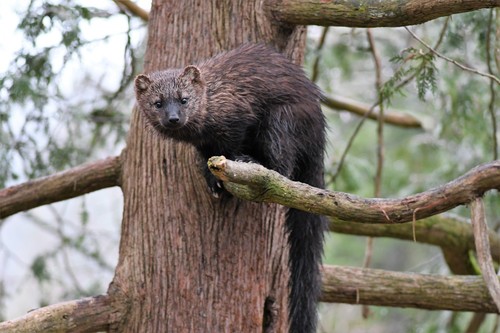
Fisher
Pekania pennanti
A shadow in the canopy and a ghost on the forest floor, the fisher is one of North America's most mysterious and agile predators. Far from being a 'cat,' this oversized weasel is a master of the winter woods and the only animal brave enough to make a meal of a porcupine.
Quick Identification
Size
Total length 75–120 cm (30–47 in); weight 2–6 kg (4.5–13 lbs), with males being significantly larger than females.
Colors
Deep chocolate brown to nearly black fur; head and shoulders often have a 'frosted' or grizzled appearance with gold or silver guard hairs; dark legs and tail.
Key Features
- Low-slung, elongated body with short legs
- Thick, bushy tail accounting for one-third of total length
- Pointed muzzle with wide, rounded ears
- Retractable claws and ankles that rotate 180 degrees for head-first climbing.
When You’ll See Them
Geographic range
Where Does the Fisher Live?
Native to the wild landscapes of North America, the fisher is primarily a resident of the boreal forests of Canada and the northern United States. Their range extends from the Atlantic coast to the Pacific, dipping southward into the Sierra Nevada of California, the Rocky Mountains, and the regenerating forests of New England and the Appalachian Mountains. While they prefer deep timber, they are increasingly reclaiming territories in the Great Lakes region and suburban fringes where forest cover has matured.
Basemap © OpenStreetMap contributors
Behavior
The fisher is a solitary and incredibly agile member of the weasel family. Despite its common name, it does not hunt fish; instead, it is a formidable forest predator known for its ability to hunt in both the canopy and on the forest floor. They are one of the few animals that successfully prey on porcupines, using their speed to circle the rodent and attack its unprotected face before flipping it over.
While largely elusive and wary of humans, fishers have begun to expand into suburban woodlots where food is plentiful. They are active throughout the year and do not hibernate. In social terms, they are territorial, with males maintaining large home ranges that overlap with several females, though they rarely interact outside of the spring mating season.
EverydayEarth exclusive
Camera Tips
To capture a fisher on camera, focus on 'travel corridors' such as large downed logs or frozen stream beds. Fishers love to run along the tops of fallen trees to keep their feet dry and gain a vantage point, so strapping your camera to a tree facing a long log is a winning strategy. Set your camera height between 2 and 3 feet off the ground, angled slightly downward to catch their low profile.
Since fishers are incredibly fast and rarely sit still, a camera with a fast trigger speed (0.3 seconds or less) and a high-quality burst mode is essential. Using 'Video Mode' is often better than stills, as it captures the fluid, serpentine movement that is characteristic of the species. Because they are most active at night, ensure your camera has a strong 'no-glow' or 'low-glow' infrared flash that won't spook these naturally shy creatures.
Lures can be highly effective during the winter months. A small amount of fatty meat, a punctured can of sardines, or a specialized 'long-distance' mustelid scent lure placed high on a tree trunk can keep a fisher in the frame longer. Position your lure about 4-5 feet up a tree opposite the camera; this forces the fisher to stand on its hind legs or climb, providing a clear view of its chest markings and face.
Similar Species
Species that look similar or are commonly confused with Fisher.
Frequently Asked Questions
Record Fisher at your habitat
Connect a camera to start building your own species record — AI identifies every visitor automatically.