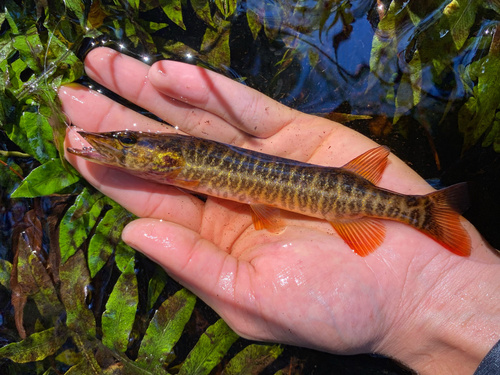
American Pickerel
Esox americanus
A pint-sized predator with a lightning-fast strike, the American Pickerel is the hidden king of the backyard pond. Discover how this camouflaged hunter uses the weeds to its advantage.
Quick Identification
Size
15-38 cm (6-15 inches) in length; typically weighs 0.1-0.5 kg (0.2-1.1 lbs)
Colors
Olive to dark green back with dark wavy vertical bars; yellowish or white underside; dark 'teardrop' mark below the eye; fins may be dusky or tipped with red.
Key Features
- Distinct dark vertical 'teardrop' bar under each eye
- Short, broad snout shaped like a duck's bill
- Dorsal and anal fins positioned far back near the tail
- Sides marked with irregular, dark vertical wavy lines
When You’ll See Them
Geographic range
Where Does the American Pickerel Live?
Native to the North American continent, the American Pickerel is primarily found across the eastern and central regions of the United States and parts of southeastern Canada. Its core range follows the Atlantic Slope from the Saint Lawrence River drainage down to Florida, as well as the Gulf Slope and the Mississippi River basin. While most populations are native to these eastern wetlands and backwaters, some localized occurrences in western states are attributed to historical introductions.
Basemap © OpenStreetMap contributors
Behavior
The American Pickerel is a master of the 'sit-and-wait' predatory style. Often found hovering motionless among dense aquatic vegetation, its patterned scales provide near-perfect camouflage against the dappled light and shadows of weed beds. It is a solitary species that stakes out a hunting territory, waiting for smaller fish or aquatic insects to swim within range before launching an explosive, lightning-fast strike.
While they are members of the pike family, they are much smaller and less aggressive than their larger relatives like the Northern Pike. They prefer the quiet, still waters of back bays and slow-moving streams where they can avoid heavy currents. In social terms, they are generally indifferent to humans, but they are highly territorial toward other fish of a similar size, often defending the best ambush spots in a pond or creek.
EverydayEarth exclusive
Camera Tips
To capture the American Pickerel on an AI-powered camera, you will need a waterproof setup or an underwater housing. Position your camera in shallow water (1-3 feet deep) near the edge of dense vegetation, such as lily pads or pondweed. Because these fish are ambush predators, they love 'edges' where they can hide in the weeds while looking out into open water. Aim the lens horizontally, about 6 inches off the sandy or silty bottom, to catch them as they cruise the perimeter of the weed bed.
Lighting is crucial for underwater shots. Try to place your camera in an area that receives bright morning or afternoon sun, which will penetrate the water and highlight the pickerel's intricate green and gold markings. Avoid murky water after heavy rains, as the sediment will interfere with the AI’s ability to trigger the recording. Using a high-frame-rate setting (60fps or higher) is highly recommended, as the pickerel’s strike is one of the fastest movements in the animal kingdom; slow-motion playback is often the only way to truly appreciate their hunting technique.
You can attract American Pickerels to your camera's field of view by using visual lures. Since they hunt by sight, hanging a shiny, hookless silver spoon or a bright ribbon near the camera can trigger their predatory curiosity. They are attracted to flash and vibration, so even a small underwater bubbler or a slow-moving propeller toy nearby can draw them in for a close-up. Check your camera regularly during the spring spawning season when they move into the shallowest waters and are most active.
Similar Species
Species that look similar or are commonly confused with American Pickerel.
Frequently Asked Questions
Record American Pickerel at your habitat
Connect a camera to start building your own species record — AI identifies every visitor automatically.