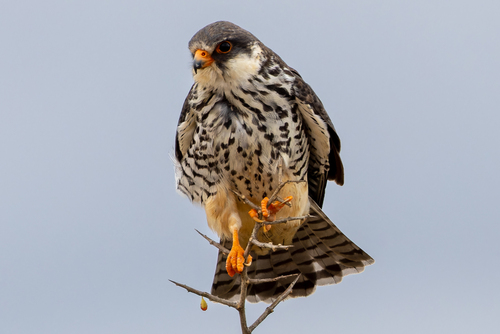
Amur Falcon
Falco amurensis
Witness the marathon traveler of the raptor world. The Amur Falcon completes a staggering 22,000-kilometer annual loop between the grasslands of Asia and the savannas of Africa.
Quick Identification
Size
Length: 26–30 cm (10–12 in); Wingspan: 63–71 cm (25–28 in); Weight: 97–188 g (3.4–6.6 oz)
Colors
Males are sooty-grey with rufous (reddish-brown) thighs and vent. Females have a grey-brown barred back, white underparts with dark streaks, and orange skin around the eyes.
Key Features
- Distinctive rufous 'trousers' on males
- Orange-red cere (beak base) and feet
- Long wings that reach the tip of the tail when perched
- White underwing coverts visible in flight
When You’ll See Them
Geographic range
Where Does the Amur Falcon Live?
The Amur Falcon is a world traveler that begins its life in the vast landscapes of East Asia, primarily breeding in south-eastern Siberia, Northern China, and Mongolia. As the seasons shift, these raptors embark on an incredible trans-oceanic journey, passing through Northeast India and across the Indian Ocean. They spend their winter months in the warm savannas of Southern and East Africa, spanning countries from South Africa and Namibia up to Kenya, before returning north in the spring.
Basemap © OpenStreetMap contributors
Behavior
Amur Falcons are extraordinary social athletes, best known for undertaking one of the longest migrations of any bird of prey. They are highly gregarious, often gathering in massive flocks that can number in the hundreds of thousands during their migration stopovers. During the day, they are active hunters, performing acrobatic aerial maneuvers to catch insects mid-air, a behavior known as 'hawking.' Unlike many solitary raptors, these falcons thrive in communal settings, often roosting together in large trees or on power lines during their journey.
These birds are remarkably consistent in their timing, following a rigorous annual schedule that dictates their presence in specific regions. While they are generally wary of humans, they have adapted to hunt over agricultural fields and near human-made water sources where insect prey is abundant. Their social nature makes them a spectacular sight during migration, as they fill the sky in swirling 'kettles' before settling into roosts at dusk.
EverydayEarth exclusive
Camera Tips
Capturing the Amur Falcon on an AI-powered camera requires focusing on their perching and social habits. Because they are aerial hunters, they rarely land on the ground except occasionally to drink. To increase your chances, mount your camera 10–15 feet high on a pole or structure overlooking an open meadow or field. Aim the camera at a prominent, dead horizontal branch or a high-tensile wire, which these falcons use as 'scouting posts' to spot insects.
If you are in a migration corridor, look for communal roosting sites in tall, isolated trees. Positioning your camera to capture the entry and exit of the flock during dawn and dusk can provide stunning footage. While they don't visit traditional bird feeders, they are highly attracted to water. A raised birdbath with a solar-powered dripper or fountain can entice them to land for a drink or a quick bath, especially in drier environments.
Since these birds are fast-moving, use a high shutter speed and set your camera to 'Burst Mode' (3–5 photos per trigger). Ensure the PIR sensor sensitivity is set to 'High' to capture their rapid flight path. The best time to deploy your camera is during their peak migration windows; in India, this is typically late October to November, while in Southern Africa, focus on the months of December through March.
Similar Species
Species that look similar or are commonly confused with Amur Falcon.
Red-footed Falcon
Males have grey underwings instead of white; females have more buff-colored heads compared to the Amur's grey crown.
Eurasian Hobby
Larger with a distinct 'mustache' mark and lacks the orange-red skin around the eyes.
Lesser Kestrel
Males have a blue-grey head and unspotted rufous back, unlike the uniform sooty-grey of the Amur Falcon.
Frequently Asked Questions
Record Amur Falcon at your habitat
Connect a camera to start building your own species record — AI identifies every visitor automatically.