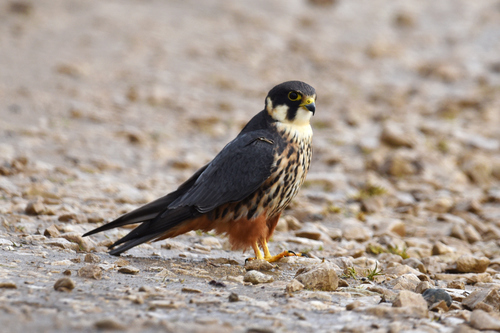
Eurasian Hobby
Falco subbuteo
The Eurasian Hobby is a master of the summer skies, a sleek and slender falcon known for its incredible aerial acrobatics and 'red trousers.' Witness the bird that can outfly a swallow and catch dragonflies in mid-air.
Quick Identification
Size
Length: 28-36 cm (11-14 in); Wingspan: 69-84 cm (27-33 in); Weight: 130-340 g (4.6-12 oz)
Colors
Slate-grey upperparts with creamy-white, heavily streaked underparts. Adults feature distinctive rufous-red 'trousers' (thighs) and vent area. White cheeks contrasted by a thick black malar stripe or 'mustache'.
Key Features
- Long, narrow scythe-shaped wings resembling a large swift
- Rusty-red feathers on the thighs and under-tail (adults)
- Distinctive white face with a heavy black mustache
- Exceptionally fast and acrobatic flight pattern
When You’ll See Them
Geographic range
Where Does the Eurasian Hobby Live?
Native to the vast temperate regions across Europe and Northern Asia, the Eurasian Hobby is a world-class traveler of the Palearctic. Its core breeding range stretches from the United Kingdom and Iberia across central Europe and Russia, extending as far east as China and Japan. Because it is a strictly migratory species, it vacates these northern territories in the autumn to spend the winter months in sub-Saharan Africa and parts of Southern Asia.
Basemap © OpenStreetMap contributors
Behavior
The Eurasian Hobby is a master of aerial agility, often described as a high-speed specialist of the falcon world. Unlike many other raptors that spend hours soaring or perching, the Hobby is frequently seen in active, scythe-like flight, chasing down dragonflies or small birds with breathtaking precision. They are crepuscular hunters, often most active during the late afternoon and dusk when large insects are abundant and swallows are returning to their roosts.
While they are solitary hunters, they can be quite vocal near their nesting sites, which are typically stolen from crows or magpies in tall trees. They do not build their own nests. During the breeding season, they exhibit incredible aerial food-passes where the male transfers prey to the female in mid-air. To humans, they are generally elusive and wary, but they have increasingly adapted to parklands and golf courses where prey is plentiful.
EverydayEarth exclusive
Camera Tips
Capturing a Eurasian Hobby on a backyard camera requires a strategy focused on their specific perching and bathing habits. Because they are high-flying aerialists, they rarely come to the ground. Your best chance is to mount a camera on a high vantage point, such as a tall fence post, a dead tree limb (snag), or a pylon overlooking an open field. Angle the camera slightly upward to catch them as they land or take off.
One of the most effective 'lures' for a Hobby is a large, elevated birdbath or a garden pond with a shallow edge. These falcons are meticulous about their plumage and will often visit water sources during the heat of the afternoon to drink and bathe. Position your camera about 2 to 3 feet from the water level, ensuring the lens is protected from splashing. Use a fast shutter speed or 'Sports Mode' if your AI camera allows it, as their movements are lightning-fast.
Seasonality is critical for this species. In Europe and Asia, you should set your cameras specifically between May and September. During the mid-summer months, when dragonflies are most active, Hobbies are more likely to frequent suburban gardens that border parks or marshes. Avoid using food bait, as they only strike live, moving prey; instead, focus on providing a safe, quiet environment with a clear flight path into the water source.
Lastly, check your camera's sensitivity settings. Hobbies are smaller and faster than Buzzards or Red Kites. If your PIR sensor is set too low, the camera may trigger only after the bird has already landed or flown away. Set the trigger to its highest sensitivity and use the 'Burst Photo' or 'High-Speed Video' setting to ensure you don't just get a blur of grey wings.
Similar Species
Species that look similar or are commonly confused with Eurasian Hobby.
Frequently Asked Questions
Record Eurasian Hobby at your habitat
Connect a camera to start building your own species record — AI identifies every visitor automatically.