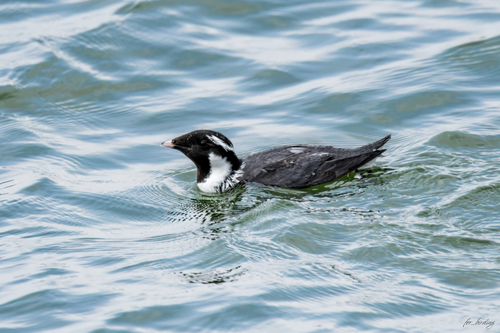
Ancient Murrelet
Synthliboramphus antiquus
The Ancient Murrelet is a master of the North Pacific, known for its striking silver 'shawl' and a truly remarkable upbringing. These tiny seabirds lead their chicks on a perilous midnight run to the ocean just two days after they hatch.
Quick Identification
Size
Length 24-27 cm (9.5-10.5 in); Wingspan 43-46 cm (17-18 in); Weight 175-250 g (6-9 oz)
Colors
Slate-grey back and upper wings, black crown and throat, white underparts, and distinctive white streaks on the neck and head during breeding season.
Key Features
- Grey 'shawl' on back and shoulders
- Black cap and throat contrasting with white underparts
- Small, pale yellow or horn-colored bill
- White plume-like feathers above and behind the eye
When You’ll See Them
Geographic range
Where Does the Ancient Murrelet Live?
Native to the North Pacific, the Ancient Murrelet occupies a vast arc of coastline and open water. They are primarily found from the Yellow Sea and Japan, up through the Aleutian Islands of Alaska, and down the Pacific coast of North America to British Columbia and Washington state. While their core breeding range is centered on the islands of the Canadian and Alaskan panhandles, they migrate south in the winter, occasionally reaching as far as Baja California and coastal China.
Basemap © OpenStreetMap contributors
Behavior
The Ancient Murrelet is a highly specialized seabird with a fascinating social structure. Unlike most birds, they are precocial; chicks hatch and stay in the nest for only about 48 hours. Under the cover of night, the parents call to their chicks from the surf, and the tiny fluffballs must navigate through the forest and across the beach to join their parents at sea, where they are raised entirely on the open water. This strategy helps them avoid predators like gulls and ravens that patrol the nesting colonies during the day.
At sea, they are gregarious and often found in small groups, diving in unison to hunt. They are exceptional swimmers, using their wings to 'fly' underwater in pursuit of prey. While they are silent at sea, they become incredibly vocal at their breeding colonies, filling the night air with whistles and chirps as they locate their burrows or communicate with mates. Their interaction with humans is limited to coastal sightings or researchers, as they spend the vast majority of their lives far from shore.
EverydayEarth exclusive
Camera Tips
Capturing the Ancient Murrelet on camera requires a specialized approach because they are strictly nocturnal when visiting land. If you live in a coastal area or have access to an island colony, your best bet is to position your camera near the base of large, old-growth trees or rocky crevices where they might burrow. Look for small entry holes with visible 'wear' or white droppings nearby. Set your camera at a very low height—no more than 6 to 12 inches off the ground—and angle it slightly upward to capture the birds as they land or waddle toward their burrows.
Because these birds are sensitive to bright lights, it is crucial to use a 'No-Glow' or high-quality Invisible Infrared (940nm) flash. Traditional white flashes or even 'Low-Glow' red LEDs can startle the birds or attract predators like raccoons and minks to the site. Fast trigger speeds are essential; when the chicks make their dash for the ocean, they move incredibly quickly, and a slow camera will only capture a blur of grey fluff.
Video mode is highly recommended over still photos for this species. The sound of the parents calling from the water and the chicks' response is a key part of their behavior that stills simply can't capture. Set your video length to 15-20 seconds with a high sensitivity setting on the PIR sensor. Since they are most active during the darkest hours of the night (usually 11 PM to 3 AM), ensure your batteries are fresh, as cold coastal nights and heavy IR use will drain them quickly.
Similar Species
Species that look similar or are commonly confused with Ancient Murrelet.
Frequently Asked Questions
Record Ancient Murrelet at your habitat
Connect a camera to start building your own species record — AI identifies every visitor automatically.