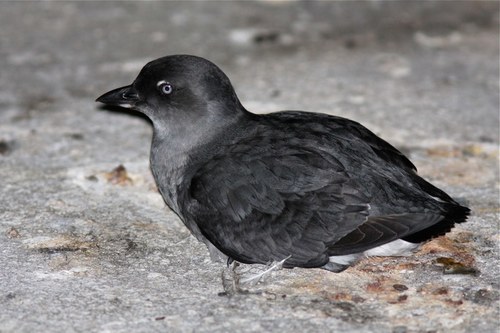
Cassin's Auklet
Ptychoramphus aleuticus
A pint-sized powerhouse of the Pacific, the Cassin's Auklet is a mysterious seabird that lives its life between the deep blue sea and secret underground burrows. Discover how this 'football with wings' survives the rugged North American coastline.
Quick Identification
Size
Length: 20-25 cm (8-10 in); Wingspan: 30-40 cm (12-16 in); Weight: 150-200 g (5.3-7.1 oz)
Colors
Dull gray-black upperparts and throat; pale gray breast fading to a white belly; distinctive white crescent markings above and below the eyes.
Key Features
- Small, stocky 'football' body shape
- White crescent markings around the eyes
- Small pale spot at the base of the lower mandible
- Short, blunt wings designed for underwater swimming
When You’ll See Them
Geographic range
Where Does the Cassin's Auklet Live?
The Cassin's Auklet is a native of the North American Pacific coast, with a range extending from the Aleutian Islands in Alaska down to the southern tip of Baja California, Mexico. The core of their breeding population is concentrated on isolated, uninhabited offshore islands in British Columbia and the Farallon Islands off California. They are strictly marine birds that are rarely seen from the mainland unless driven toward the coast by severe winter storms or during deep-sea foraging trips.
Basemap © OpenStreetMap contributors
Behavior
Cassin's Auklets are remarkably social seabirds that spend the vast majority of their lives on the open ocean. They are exceptional divers, using their short, powerful wings like flippers to 'fly' underwater in pursuit of zooplankton and small fish. Because they are vulnerable to avian predators like gulls and raptors, they have evolved a strictly nocturnal schedule when visiting their breeding colonies, arriving and departing under the cover of darkness to minimize risk.
On land, they are somewhat clumsy but determined, waddling to their nesting burrows which they dig into the soft soil or rock crevices of offshore islands. They are known for their loud, rasping vocalizations that can turn a quiet island into a cacophony of sound after midnight. While they don't interact directly with humans, they are highly sensitive to changes in ocean temperature and food availability, making them important biological indicators for the health of the North Pacific ecosystem.
EverydayEarth exclusive
Camera Tips
Capturing the Cassin's Auklet on a trail camera is a unique challenge because they are almost entirely nocturnal when they visit land. To see them, your camera must be placed on a known nesting island during the breeding season. Position your camera near the entrance of a burrow, which typically looks like a small hole in the ground or under thick coastal vegetation. Use a low-angle mount or a ground stake to ensure the lens is only a few inches off the ground, as these birds stay low to avoid detection by gulls.
Because they only appear in the dark, high-quality infrared (IR) night vision is essential for your camera setup. Avoid using cameras with white-light flashes, as this will startle the birds and may inadvertently attract predators to their nesting site. Set your camera to a fast trigger speed and high-sensitivity PIR (passive infrared) setting; these birds move quickly and clumsily as they scurry from the air into their burrows. A 'burst mode' of 3-5 photos is usually more effective than video for capturing the quick moment they land.
Since these are seabirds, your equipment needs to be rugged and weather-sealed against salt spray and high coastal humidity. If you are setting up a camera in a burrow (a popular method for researchers), use a specialized 'borescope' or endoscope camera with low-intensity LED lighting. For trail cameras near the colony, the best time to capture activity is between midnight and 3:00 AM. No bait is necessary or recommended, as the birds are driven by the biological instinct to return to their chicks or mates.
Similar Species
Species that look similar or are commonly confused with Cassin's Auklet.
Common Murre
Much larger and taller with a pointed bill; lacks the white eye crescent and has a white breast compared to the Auklet's gray.
Rhinoceros Auklet
Larger with a distinct 'horn' on the bill during breeding season and two white facial plumes on the head.
Parakeet Auklet
Features a more rounded, orange-red bill and is typically found further north in the Bering Sea.
Frequently Asked Questions
Record Cassin's Auklet at your habitat
Connect a camera to start building your own species record — AI identifies every visitor automatically.