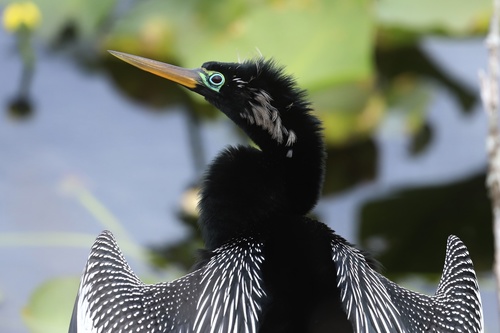
Anhinga
Anhinga anhinga
Often mistaken for a swimming serpent, the Anhinga is a master of the wetlands. With its spear-like bill and silver-streaked wings, it is one of the most striking birds you'll find in the southern sun.
Quick Identification
Size
Length: 75–95 cm (30–37 in); Wingspan: 109 cm (43 in); Weight: 1.0–1.3 kg (2.2–2.9 lbs)
Colors
Males are glossy black with silver-white streaks on the wings and back; females have a distinctive light tan head, neck, and upper breast.
Key Features
- Long, dagger-like pointed bill
- Slender, snake-like neck
- Silver-white feather patterns on upper wings
- Large, fan-shaped tail used for soaring
When You’ll See Them
Sightings on EverydayEarth
Jul 19, 2026
A group of waterbirds is perched across the bare branches of a large tree. Four Anhingas are visible on the higher limbs; one in the center is actively preening its feathers. A Great Egret stands prominently on a lower branch, occasionally stretching its long neck, while a smaller Tricolored Heron perches just above it, looking out over the swamp.
Jul 16, 2026
Two Anhingas are perched on the skeletal branches of a dead tree against a backdrop of towering cumulus clouds. The bird on the left is seen with its bill agape, likely gular fluttering to regulate its body temperature in the heat. A third, white-feathered bird is partially visible on the far right edge of the frame.
Jul 14, 2026
Three Anhingas are perched on weathered tree branches overlooking the swamp. One individual on the right is actively preening its feathers, while another on the left stretches its exceptionally long, snake-like neck toward the sky. A third bird is partially visible lower on the vertical branch.
Jul 9, 2026
A group of Roseate Spoonbills is perched in a large tree overhanging the water. Some of the birds are preening their pink feathers, while others rest on the branches. Higher up in the tree, a dark Anhinga and several white Great Egrets are also present, indicating a shared rookery site. The birds are relatively calm, with one bird seen taking flight from the lower right near the end of the footage.
Jul 5, 2026
A female or immature Anhinga is perched on a weathered branch, looking out over the swamp in the early morning light. It remains mostly still, occasionally turning its head to scan the surroundings.
Jun 28, 2026
A Snowy Egret forages along the shoreline in the foreground, its bright yellow feet visible as it steps through the mud. In the center, an Anhinga walks from the bank into the water, while an American Alligator floats nearly motionless near some fallen logs in the middle of the swamp.
Geographic range
Where Does the Anhinga Live?
The Anhinga is a native specialist of the warmer regions of the Americas, thriving in both the Northern and Southern Hemispheres. Its core range begins in the southeastern United States, particularly Florida and the Gulf Coast, and extends through Mexico and Central America into the tropical heart of South America as far south as Argentina. While they are year-round residents in most of their range, some northern populations in the U.S. may move southward during particularly cold winters.
Basemap © OpenStreetMap contributors
Behavior
The Anhinga is famously known as the 'Snakebird' because of its habit of swimming with its entire body submerged, leaving only its long, slender neck and head visible above the water. This gives the appearance of a snake moving through the reeds. Unlike many other water birds, Anhingas do not have waterproof feathers. While this makes them less buoyant and better divers, it also means they get waterlogged easily.
To dry off after a hunt, they spend hours perched on branches with their wings spread wide to catch the sun's rays. This iconic 'sunning' posture is a common sight along lake edges. They are solitary hunters but often share nesting colonies with other wading birds like egrets and herons. Despite their somewhat prehistoric appearance, they are graceful fliers and can often be seen soaring high on thermal air currents like hawks.
EverydayEarth exclusive
Camera Tips
To capture high-quality footage of an Anhinga, your best bet is to locate their favorite drying perch rather than trying to film them in the water. Look for dead branches or logs that extend into the water in sunny, wind-protected areas. Mount your camera on a nearby tree or post at a height of 3-5 feet, angled slightly downward toward the perch. Because Anhingas often return to the same spot daily to dry their wings, a fixed camera position is highly effective.
Since these birds are active during the day, you don't need to worry about infrared range, but you should prioritize a camera with a high trigger speed. Anhingas can be very still while sunning, so setting your camera to 'Video Mode' or 'Burst Mode' is essential to capture the moments when they stretch their necks, preen their feathers, or suddenly dive into the water. If your camera supports it, a time-lapse setting during the mid-morning hours can produce a beautiful sequence of the drying process.
If you have a backyard pond, you can attract them by ensuring there are 'loafing' spots—submerged logs that break the surface are ideal. Avoid placing cameras too close to active nests, as this can stress the birds; instead, focus on the edges of the water where they forage. Anhingas are visual hunters, so keeping the water surface clear of heavy debris in front of your camera's field of view will help you catch clear shots of their 'snake-neck' swimming style.
Similar Species
Species that look similar or are commonly confused with Anhinga.
Frequently Asked Questions
Record Anhinga at your habitat
Connect a camera to start building your own species record — AI identifies every visitor automatically.