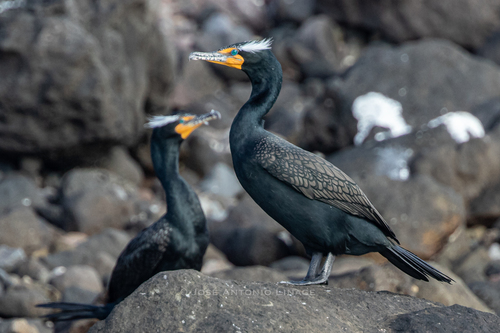
Double-crested Cormorant
Nannopterum auritum
A striking sight on the water's edge, the Double-crested Cormorant is known for its primitive silhouette and its signature wing-drying pose. These resilient waterbirds are a testament to conservation success, having rebounded to become common across North American waterways.
Quick Identification
Size
Length: 70–90 cm (27.5–35.5 in); Wingspan: 114–123 cm (45–48 in); Weight: 1.2–2.5 kg (2.6–5.5 lbs)
Colors
Adults are matte black with a bronzy sheen on the wings. They feature a bright orange-yellow patch of skin on the throat and face. During breeding, they possess teal-blue eyes and small white or black tufts (crests) above the eyes. Immatures are dark brown with a paler tan chest and throat.
Key Features
- Hooked bill with a sharp tip for gripping fish
- Large orange-yellow throat pouch
- Distinctive 'wing-drying' posture with feathers spread wide
- Snake-like neck profile when swimming low in the water
- V-shaped flight formations similar to geese
When You’ll See Them
Geographic range
Where Does the Double-crested Cormorant Live?
The Double-crested Cormorant is a true North American native, boasting one of the most expansive distributions of any waterbird on the continent. From the frigid coastlines of the Aleutian Islands and Newfoundland down to the tropical shores of Florida, Mexico, and even parts of the Caribbean, these birds are a common sight near almost any significant body of water. While many populations are migratory—moving south from Canada and the northern United States as lakes freeze—southern populations along the Gulf Coast and Pacific remain residents year-round.
Basemap © OpenStreetMap contributors
Behavior
They are gregarious nesters, often forming dense colonies that can include hundreds of individuals. In the water, they swim low with only their neck and head visible, disappearing for long periods to chase prey. While they are generally quiet, they can emit low, guttural grunts at nesting sites. In suburban areas, they have become quite bold, frequently using man-made structures like bridges and boat docks as resting platforms.
EverydayEarth exclusive
Camera Tips
Because cormorants are strictly diurnal and most active during the middle of the day when the sun is high for drying feathers, avoid relying on infrared night mode. Instead, prioritize cameras with high dynamic range (HDR) settings to handle the high-contrast glare reflecting off the water and the bird's dark plumage. A fast shutter speed is essential if you hope to catch them in the act of landing or taking off, as their heavy-bodied departures are surprisingly powerful and splashy.
You don't need traditional bait for these birds; instead, 'lure' them by providing an attractive place to land. If you have a backyard pond or lakefront, a simple floating platform or a securely anchored branch can become a magnet for cormorants looking for a rest. During the spring breeding season, you may capture their unique 'double crest' tufts, so ensure your camera is positioned to capture side profiles which highlight these temporary feathers and their striking teal-colored eyes.
Similar Species
Species that look similar or are commonly confused with Double-crested Cormorant.
Anhinga
Features a straight, pointed bill rather than a hooked one, and a much longer, fan-like tail.
Great Cormorant
Larger with a white patch on the throat and thighs, and lacks the bright orange facial skin of the Double-crested.
Neotropic Cormorant
Smaller with a longer tail and a white 'V' shape bordering the throat patch.
Frequently Asked Questions
Record Double-crested Cormorant at your habitat
Connect a camera to start building your own species record — AI identifies every visitor automatically.