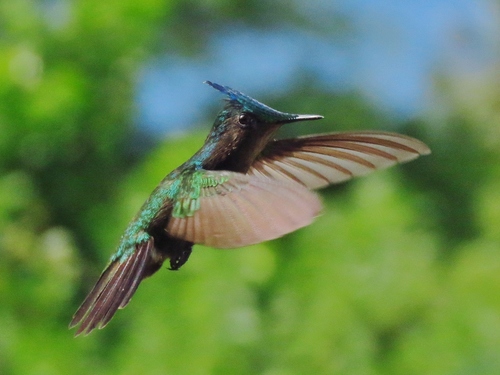
Antillean Crested Hummingbird
Orthorhyncus cristatus
A tiny, crested jewel of the West Indies, the Antillean Crested Hummingbird brings a flash of iridescent green and a bold personality to every Caribbean garden it visits.
Quick Identification
Size
Length 8-9 cm (3.1-3.5 in); Wingspan approx. 11-12 cm (4.5 in); Weight 3.5-4 g (0.12-0.14 oz)
Colors
Males feature a metallic green crest with a blue/purple tip and dark grey underparts; females lack the crest and have a pale grey throat and breast.
Key Features
- Distinctive pointed, iridescent green or blue-tipped crest on males
- Short, straight black bill
- Dull greyish-brown to blackish underparts
- Small, rounded wings and a slightly notched tail
When You’ll See Them
Geographic range
Where Does the Antillean Crested Hummingbird Live?
This vibrant species is a native gem of the Caribbean, primarily found throughout the West Indies. Its core range extends from the eastern regions of Puerto Rico across the entire archipelago of the Lesser Antilles, reaching as far south as Grenada and Barbados. While they are considered permanent residents of these tropical islands, they are occasionally recorded as rare vagrants in the southern United States, particularly in Florida.
Basemap © OpenStreetMap contributors
Behavior
The Antillean Crested Hummingbird is a high-energy acrobat, often seen darting between tropical blooms with incredible speed. Unlike many larger birds, these hummingbirds are fiercely territorial, often guarding a specific cluster of flowers or a backyard feeder against intruders—even those twice their size. You will often hear them before you see them, as their wings produce a characteristic humming sound accompanied by sharp, high-pitched 'tsip' calls.
These birds are remarkably adapted to human presence, frequently visiting garden verandas and urban parks throughout the Caribbean. They spend a significant portion of their day hovering to feed on nectar, but they also perform impressive aerial maneuvers to catch tiny insects mid-air. In the heat of the day, they can be found perched on thin, shaded branches, preening their iridescent feathers to maintain their aerodynamic efficiency.
EverydayEarth exclusive
Camera Tips
To capture the stunning iridescence of the Antillean Crested Hummingbird, place your AI-powered camera within 2 to 3 feet of a nectar source. These birds are particularly drawn to red or orange tubular flowers like Firebush or Shrimp Plant. If you are using a hummingbird feeder, ensure the camera is positioned at eye level with the feeding ports, but try to angle it so the sun is behind the camera. This 'front-lighting' is essential to make the male's metallic crest pop with color in your photos and videos.
Because of their rapid wing beats, use a camera setting with a very high shutter speed (1/2000s or faster) if manual overrides are available. If your camera relies on motion triggers, set the sensitivity to 'High' because these birds are small and move with lightning speed. A 'Burst' or 'Rapid-fire' mode is your best friend here, as it increases the chances of catching the bird with its wings spread or its crest fully flared toward the lens.
Don't just focus on the flowers; look for 'perching stations.' These hummingbirds often return to the same bare twig or clothesline to rest between feedings. Placing a second camera near a known perch can provide intimate shots of the bird preening or resting, which often results in clearer, more detailed images than those taken while the bird is in mid-hover. In the Caribbean heat, midday activity might drop, so focus your monitoring efforts during the 'golden hours' of early morning and late afternoon when light is soft and the birds are most active.
Similar Species
Species that look similar or are commonly confused with Antillean Crested Hummingbird.
Green-throated Carib
Much larger with a distinctly decurved (down-turned) bill and no crest.
Puerto Rican Emerald
Lacks the pointed crest and has a more deeply forked tail; found primarily in Puerto Rico.
Blue-headed Hummingbird
Found only in Dominica and Martinique; the male has a blue head rather than a green/blue crest.
Frequently Asked Questions
Record Antillean Crested Hummingbird at your habitat
Connect a camera to start building your own species record — AI identifies every visitor automatically.