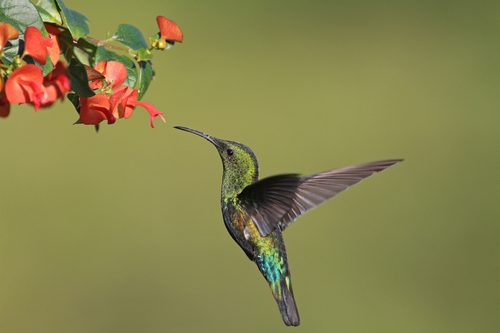
Green-throated Carib
Eulampis holosericeus
A shimmering gem of the Caribbean islands, the Green-throated Carib is a bold hummingbird known for its brilliant emerald throat and assertive personality. Thriving in lush tropical gardens, it is a favorite for backyard birdwatchers across the Lesser Antilles.
Quick Identification
Size
11–12.5 cm (4.3–4.9 in) long; wingspan approx. 15 cm (6 in); weight 5–8 g (0.18–0.28 oz)
Colors
Overall dark, velvety green-black body with a brilliant iridescent emerald-green throat and a small, vibrant violet-blue patch on the upper breast.
Key Features
- Brilliant metallic green throat and chin
- Distinct violet-blue patch on the upper breast
- Long, black, slightly decurved bill
- Broad tail with a dark bluish-green sheen
When You’ll See Them
Geographic range
Where Does the Green-throated Carib Live?
The Green-throated Carib is a signature resident of the Caribbean, native to the islands of the West Indies. Its core range spans from Puerto Rico and the Virgin Islands southward throughout the Lesser Antilles, reaching as far south as Grenada. It is a highly adaptable island specialist that thrives in both lush mountain slopes and arid coastal gardens.
Basemap © OpenStreetMap contributors
Behavior
The Green-throated Carib is a bold and highly territorial hummingbird known for its assertive nature. Unlike many smaller hummingbird species that may flee when larger birds arrive, this carib often holds its ground at nectar sources, aggressively chasing away competitors—including other hummingbirds and even larger birds like Bananaquits. They are 'trap-line' feeders, meaning they follow a routine route between specific flowering plants, but they will fiercely defend a particularly rich food source like a garden feeder or a blooming Heliconia patch.
In backyard settings, they are remarkably curious and can become accustomed to human presence. They spend much of their day alternating between high-energy foraging and perching on exposed twigs or power lines to survey their territory. Their flight is characterized by rapid, direct movements and a distinct humming sound produced by their wings. During the breeding season, which varies by island, they are known for their spirited aerial displays.
EverydayEarth exclusive
Camera Tips
To capture the best footage of a Green-throated Carib, position your AI-powered camera near nectar-rich plants such as Heliconia, Ixora, or Cape Honeysuckle. These birds are creatures of habit and will return to the same blooms multiple times an hour. Set your camera at eye level with the flowers, approximately 3 to 5 feet away, to ensure the motion sensor triggers as they hover. Using a camera with a high-speed trigger or 4K video capability is essential to freeze the rapid wing movement and catch the details of their iridescent plumage.
Lighting is the most critical factor for capturing the Carib’s stunning colors. The 'green' throat and 'blue' breast patch are structural colors, meaning they only shimmer when light hits them at the right angle. Position your camera so the sun is behind or slightly to the side of the lens during the morning or late afternoon. This 'golden hour' light will illuminate the iridescent feathers, turning what might look like a dark, blackish bird into a glowing emerald gem.
If you use a hummingbird feeder to attract them, choose one with a perch. While these birds are master hoverers, they often prefer to land while drinking from a stationary source, which provides a much cleaner, more stable image for your camera. Keep the feeder clean and filled with a simple 1:4 white sugar-to-water ratio. If one dominant Green-throated Carib is being too aggressive and chasing others away from your camera's view, try placing a second feeder on the opposite side of your house or yard to capture more diverse activity.
Similar Species
Species that look similar or are commonly confused with Green-throated Carib.
Purple-throated Carib
Larger with a brilliant velvety-purple throat and lacks the green throat and blue breast patch of the Green-throated Carib.
Antillean Crested Hummingbird
Much smaller with a prominent pointed crest on its head, which the Green-throated Carib lacks.
Blue-headed Hummingbird
Found only on Dominica and Martinique; it has a bright blue head and a more restricted forest habitat compared to the widespread Green-throated Carib.
Frequently Asked Questions
Record Green-throated Carib at your habitat
Connect a camera to start building your own species record — AI identifies every visitor automatically.